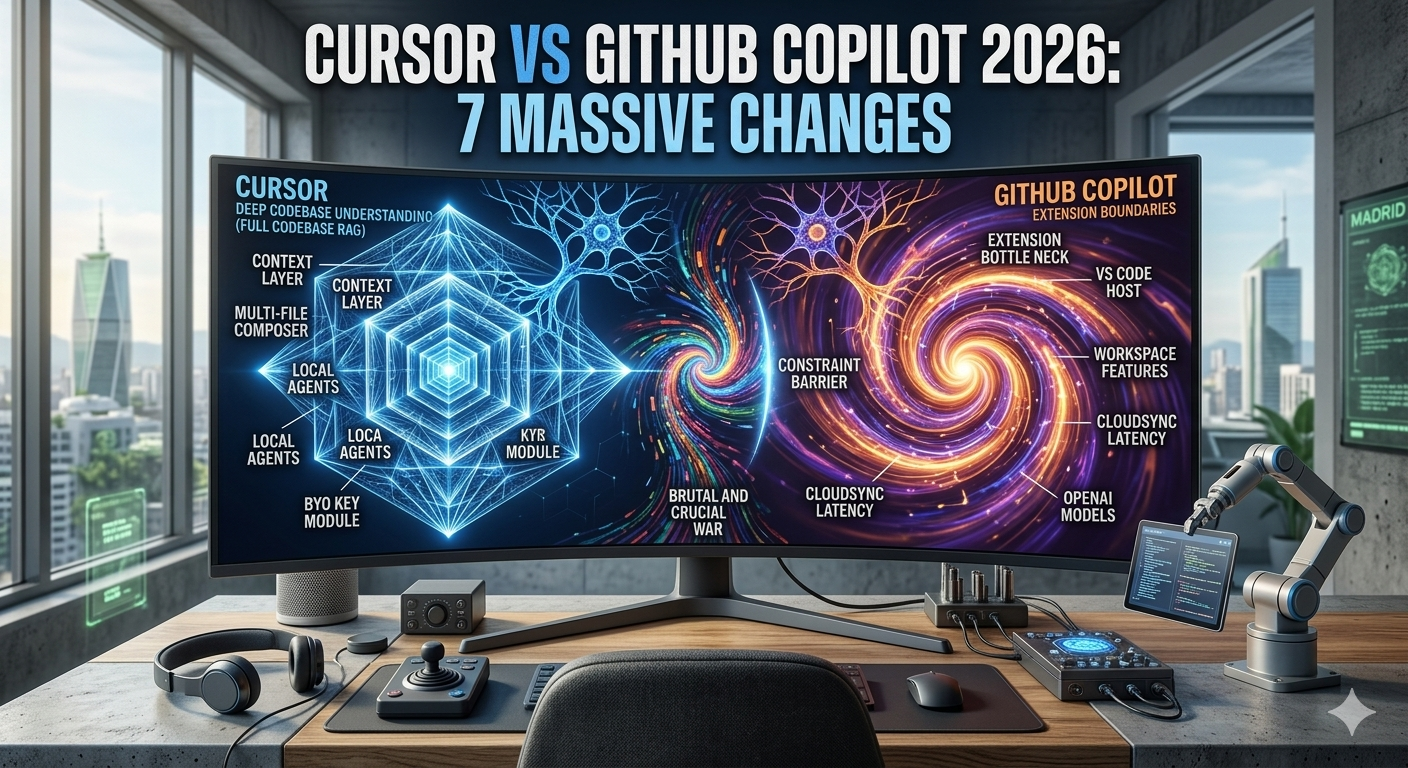
The landscape of software development isn’t just evolving; it’s being fundamentally rewritten. In 2026, the developer’s primary tool is no longer just an editor, but an intelligent agent. The battle for supremacy in this space has boiled down to a fundamental conflict: Cursor vs GitHub Copilot 2026. This isn’t just a minor tool preference debate anymore; it’s a decision that defines your entire engineering workflow and your speed in a hyper-competitive market.
We’ve moved far beyond the days of simple autocompletion. The tools we’re discussing now are agents capable of understanding massive, complex codebases, writing entire features, and even debugging their own mistakes before you even hit “save.” I’ve spent months deeply integrated with both to bring you this raw analysis of the Cursor vs GitHub Copilot 2026 rivalry.
The core dilemma in the Cursor vs GitHub Copilot 2026 era is simple yet profound. Do you use an intelligent extension (GitHub Copilot) attached to a popular editor, or do you adopt a whole new editor built from the ground up for AI (Cursor)? The answer impacts your speed, context awareness, and crucially in this year, your data privacy and intellectual property security.
The Shift from Extensions to Integrated Environments
Back in 2024, the choice seemed easier. Most devs simply added GitHub Copilot to VS Code. But the game changed when AI agents proved they needed deep control of the editor state to be truly effective. This shift is a crucial part of the broader rise of essential AI software 2026, where “intelligent integration” became the primary metric for developer productivity.
The limitations of extensions became obvious in the Cursor vs GitHub Copilot 2026 competition: they were architectural bottlenecks. They couldn’t “see” your whole terminal history, index your local documentation, or interact with your file explorer without awkward workarounds. To understand how these tools fit into the current market, you can check the official GitHub Copilot documentation and the Cursor AI official site to see their latest 2026 enterprise updates.
GitHub Copilot: The Refined Veteran
In this clash of Cursor vs GitHub Copilot 2026, Copilot remains the standard-bearer for corporate stability. It is Microsoft and GitHub’s polished, deeply embedded solution. It has refined its capabilities significantly, leveraging the full power of OpenAI’s latest specialized coding models and Azure’s massive infrastructure.
What Copilot Wins On:
- Ecosystem Lock-in: If you are a VS Code die-hard, Copilot feels like part of the furniture. There is zero friction to start.
- GitHub Integration: Its integration with the broader GitHub ecosystem—PR reviews, automated testing, and issue tracking—is superb.
- Corporate Trust: For many enterprise teams, Copilot is the only “approved” tool in the Cursor vs GitHub Copilot 2026 debate because of Microsoft’s ironclad security layers.
- Language Support: Its knowledge base across nearly every language imaginable remains staggering, including legacy systems.
But the veteran has an Achilles heel. When discussing Cursor vs GitHub Copilot 2026, you cannot ignore the constraint that Copilot must operate within the extension boundaries of VS Code. For further context on how extensions interact with productivity, check our analysis on the best AI tools Chrome extensions 2026.
Cursor: The Aggressive Challenger
Cursor is not just an extension. It is a fork of VS Code itself. This distinction is the most critical element in the Cursor vs GitHub Copilot 2026 debate. By owning the entire editor, Cursor has unfiltered access to every part of your development context—from the AST (Abstract Syntax Tree) to your local environment variables.
What Cursor Wins On:
- Deep Contextual Awareness: Cursor’s “Composer” is light-years ahead in understanding how changes in one file affect another three directories over.
- Multimodal Integration: In 2026, Cursor doesn’t just read code. You can paste screenshots of UI bugs or even hand-drawn architecture sketches directly into the chat for instant implementation.
- Agentic Workflows: When comparing Cursor vs GitHub Copilot 2026, Cursor can naturally open multiple files, create new boilerplate, run terminal commands, and apply complex refactors simultaneously.
- Privacy-First Approach: Cursor has built its reputation on local-first privacy. We explored similar privacy dynamics when comparing tools like Claude 3.5 vs ChatGPT 4o, highlighting how data sovereignty is a massive decision factor for modern devs.
This approach—building an editor for AI—is what separates a great tool from a transformative one in the Cursor vs GitHub Copilot 2026 era. It mirrors the need for specific agents, a concept we covered in the best AI agents for business 2026.
Comparison Table: Feature Matrix 2026
Below is a detailed, focused breakdown of the key differentiators that define the Cursor vs GitHub Copilot 2026 landscape.
| Feature Group | Cursor AI Editor | GitHub Copilot (VS Code) |
|---|---|---|
| Integration Level | Host (Owns Editor) | Guest (Extension) |
| Context Awareness | Excellent (Full Codebase RAG) | Good (Recent File Cache) |
| Agentic Actions | Native (Can edit 10+ files at once) | Iterative (File by file flow) |
| Multimodal Input | Full (Images, PDF, Docs) | Partial (Image support in Chat) |
| Model Flexibility | High (BYO Key + Toggle) | Fixed (OpenAI Models) |
Codebase Understanding: The Definitive Battleground
The single feature that makes engineers switch in the Cursor vs GitHub Copilot 2026 battle is its ability to “see” your whole project. This is the difference between asking someone to help you write a paragraph versus asking them to help you write a chapter of a book they’ve already read.
When you use Cursor, it builds a local, high-speed index of your repository. This means when you ask, “Where is the API endpoint for user updates and which middleware protects it?” it understands the semantic relationship across your backend. This is why many consider it the leader in productive AI tools 2026.
Copilot’s “Workspace” is trying to close this gap by leveraging cloud-side indexing, but the latency and privacy trade-offs remain a hurdle. For high-level discussions about building complex systems, you can see similar limitations in our Perplexity vs SearchGPT 2026 comparison.
Real-world Workflow Scenarios in 2026
Let’s put the Cursor vs GitHub Copilot 2026 competition into perspective with a real implementation of a complex feature like a “Ghost Company” module.
- In GitHub Copilot: You type a comment describing a flow. Copilot suggests code for that file. You then manually create other files. You have to provide the context to Copilot at each step, which slows down the process significantly.
- In Cursor: You use “Composer.” You tell the AI: “Build a ghost company module following the logic in our build ghost company AI guide.” Cursor will open a new workflow, create the files, and even show you the
git difffor all changes simultaneously. The productivity gain in the Cursor vs GitHub Copilot 2026 race is staggering. It connects deeply with how to build automated AI workflow guide 2026, as your IDE is now acting as a proactive partner.
The Learning Curve: Friction vs. Reward
When evaluating Cursor vs GitHub Copilot 2026, we must discuss the “onboarding” experience.
GitHub Copilot requires almost zero learning. If you know how to use VS Code, you know how to use Copilot. It is the “safe” bet for teams that don’t want to disrupt their existing habits. However, this safety comes at the cost of the massive efficiency gains found in deeper integrations.
Cursor, while based on VS Code, introduces new mental models. You have to learn how to prompt the “Composer,” how to manage “Chat” context, and how to use the @ symbol to reference specific files or docs. In the Cursor vs GitHub Copilot 2026 landscape, this slight learning curve pays off within 48 hours for most senior developers, but it can be a hurdle for junior teams.
Security, Privacy, and Corporate Compliance
Privacy is a critical pillar of the Cursor vs GitHub Copilot 2026 choice. In 2026, data leaks via LLMs have become a major enterprise risk. Cursor’s local-indexing means your proprietary logic stays on your machine more often. If you are interested in how global developers feel about these risks, check the Stack Overflow Developer Survey for the latest 2026 trends on AI adoption and security concerns.
Furthermore, the Cursor vs GitHub Copilot 2026 rivalry is forcing innovation in “Small Language Models” (SLMs) that run locally. Cursor is currently winning the race to integrate these local models, allowing you to code while offline or in highly secure environments where cloud access is restricted.
The Verdict: Extension or Environment?
The Cursor vs GitHub Copilot 2026 debate doesn’t have a single answer, but it does have a winner depending on your developer persona and project scale.
Who Should Stick with GitHub Copilot:
- VS Code Traditionalists: If you have custom configurations or legacy plugins that you cannot bear to migrate to a fork.
- Enterprise Teams: If your company mandates Microsoft-only ecosystem tools for legal and compliance reasons.
- Subtle Assistance: If you primarily just want autocompletion without the AI “taking over” the editor in the Cursor vs GitHub Copilot 2026 era.
Who Should Switch to Cursor Today:
- Context-Driven Engineers: If you work on complex, multi-file codebases and need the AI to “know” every corner of your project.
- Agentic Builders: If you want an AI that manages multiple file changes, writes tests, and runs terminal commands autonomously.
- Privacy-First Developers: If you need absolute control over which models touch your code and prefer a local-first approach in the Cursor vs GitHub Copilot 2026 landscape.
- Full-Stack Creators: If you are managing everything from backend to UI, especially when using modern tools like the 7 best AI music generators 2026 for creative apps.
Both Microsoft and Cursor are moving aggressively. Copilot is trying to push the boundaries of what an extension can do, while Cursor is setting the standard for what a truly integrated AI environment is. In 2026, the question in the Cursor vs GitHub Copilot 2026 war is no longer “should I use AI,” but “will I use a great extension or a perfect environment?”
As you refine your tech stack, remember that tools like how to use Claude 3.5 Sonnet artifacts 2026 can complement your IDE, regardless of whether you choose the veteran or the challenger in the Cursor vs GitHub Copilot 2026 battle. Finalize your decision by testing both on a real project—only then will you know which side of the Cursor vs GitHub Copilot 2026 war you truly belong on.