
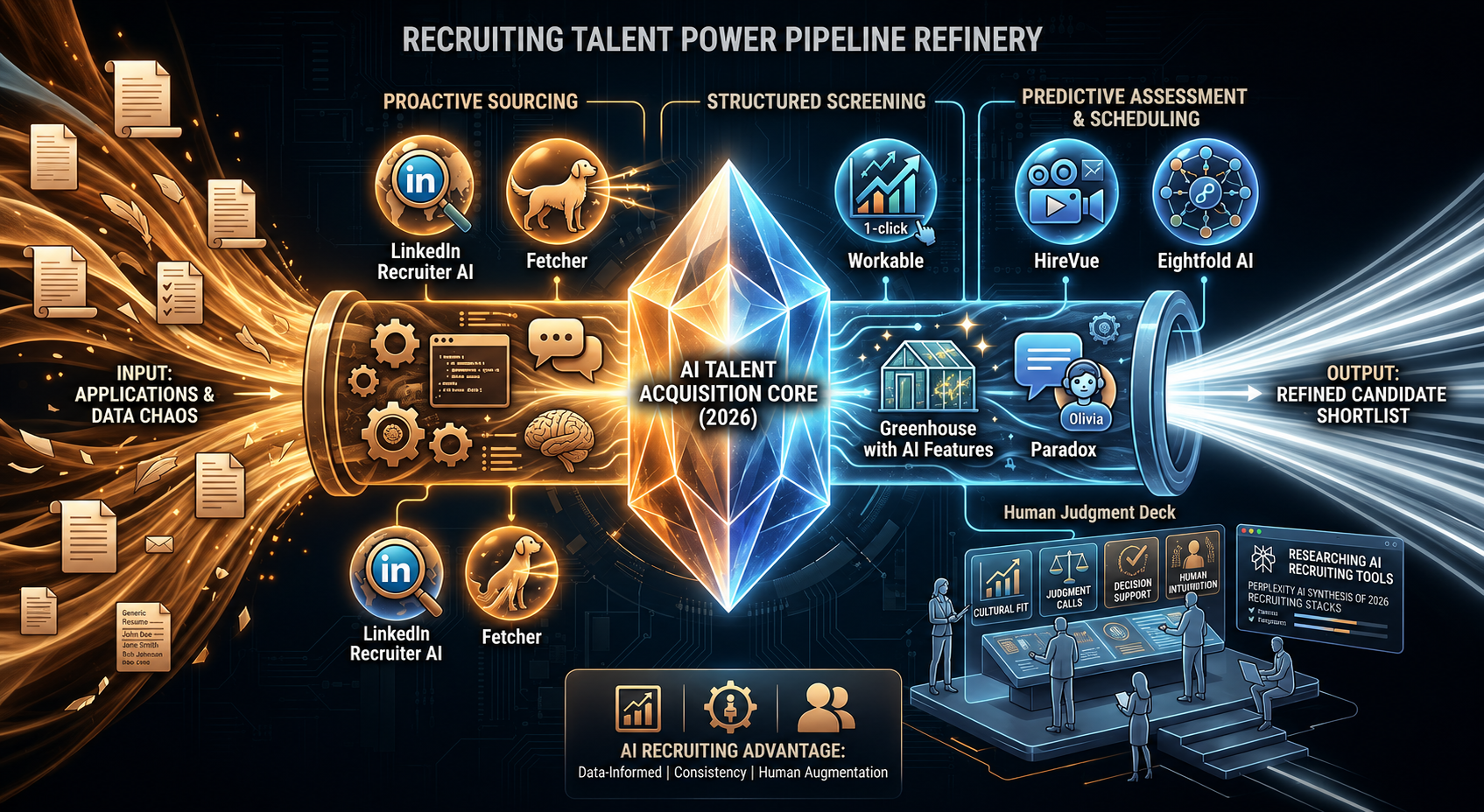
Hiring has always been one of the most time-intensive things a business does. Screening hundreds of applications, scheduling interviews, coordinating feedback across teams, writing job descriptions — most of it is administrative work that doesn’t require human judgment, but has traditionally consumed a disproportionate amount of HR time. AI recruiting tools have changed that equation. The best ones handle the operational load so that recruiters can spend their time on the decisions that actually need a human.
This guide covers the seven AI recruiting tools that are delivering real results for hiring teams in 2026 — from early-stage startups making their first few hires to enterprise talent acquisition teams processing thousands of applications per month.
Why AI Recruiting Is Different From Standard HR Software
The AI recruiting category gets lumped in with traditional applicant tracking systems, but the two are genuinely different. A standard ATS stores applications and manages workflow. An AI recruiting tool actively helps you find better candidates faster — by writing better job postings, ranking applicants against role requirements, predicting candidate quality before the first call, automating initial screening conversations, and surfacing insights about where your pipeline is breaking down.
The result is that teams using modern AI recruiting platforms consistently reduce their time-to-hire and improve the consistency of their screening process. What used to take a recruiter two weeks of manual review can often be compressed into hours without sacrificing quality.
That said, AI recruiting tools work best when they augment human judgment rather than replace it. The question of where to draw that line is one every hiring team needs to answer for themselves. Our post on AI agents for business vs human employees goes deeper on that balance.
What to Look for in AI Recruiting Tools
Before evaluating any specific platform, it helps to be clear about where in your recruiting funnel you need the most help. AI recruiting tools tend to specialize in one of three areas: sourcing (finding candidates), screening (evaluating applications and first-round fit), or interviewing and assessment (structured interviews, skills tests, and predictive scoring).
The best AI recruiting stacks combine at least two of these. They also integrate cleanly with your existing ATS and calendar tools so that automation doesn’t create new manual steps elsewhere. Pricing varies enormously in this space — some tools are priced per seat, others per hire, and others as a percentage of salary. Make sure you understand the cost model before committing to a platform that scales in unexpected ways as your hiring volume increases.
The 7 Best AI Recruiting Tools in 2026
1. LinkedIn Recruiter with AI Recommendations
LinkedIn Recruiter has become meaningfully more powerful in 2026 with the addition of AI-generated candidate recommendations, AI-assisted outreach message drafting, and intelligent search that interprets natural language queries rather than requiring Boolean syntax. You can describe an ideal candidate in plain English — “senior product manager with fintech experience who has led a team of at least five and is open to hybrid roles in Berlin” — and LinkedIn’s AI will surface the best-matching profiles from its database of over a billion members.
The AI outreach feature generates personalized first messages based on each candidate’s profile, which consistently outperforms generic InMail in response rates. For teams that do significant volume of passive candidate outreach, the time savings are substantial. LinkedIn Recruiter remains expensive for smaller teams, but for mid-market and enterprise hiring, it’s hard to match the combination of database size and AI tooling.
2. HireVue
HireVue is the leading AI recruiting platform for structured video interview assessment. Candidates record video responses to standardized interview questions, and HireVue’s AI analyzes the responses for job-relevant competencies — communication clarity, structured thinking, problem-solving approach — against a validated framework. Hiring managers receive scored summaries rather than hours of raw video to review.
For high-volume roles where scheduling live first-round interviews is impractical, HireVue compresses the screening timeline significantly while standardizing the process across all candidates. The platform integrates with most major ATS systems and includes a game-based cognitive assessment option for roles where thinking style matters as much as experience. You can explore the full feature set at hirevue.com. For teams looking at AI tools for managing meeting and interview logistics more broadly, our guide on best AI meeting assistants covers the scheduling and coordination layer.
3. Greenhouse with AI Features
Greenhouse is one of the most widely used ATS platforms in the market, and its AI recruiting features have matured considerably. The AI-assisted job description tool generates structured, inclusive job postings from a brief role outline and flags language that may discourage underrepresented candidates. The application scoring module ranks incoming applicants against the role criteria you define, so recruiters review the most promising candidates first rather than working through a queue in order of submission.
Greenhouse also provides structured interview kits with AI-suggested questions tailored to the role, which improves consistency across interviewers and makes feedback collection significantly more actionable. For companies that need to scale AI recruiting without abandoning a mature ATS workflow, Greenhouse offers one of the most practical paths forward.
4. Workable
Workable combines AI recruiting features with a full ATS in a package that’s genuinely accessible to smaller teams. Its AI sourcing tool proactively finds passive candidates on LinkedIn, GitHub, Xing, and other platforms based on your job requirements, and surfaces them directly in the platform with a one-click outreach option.
The AI job description generator and candidate screening features are clean and fast — less sophisticated than enterprise platforms like Eightfold, but more than sufficient for most teams hiring across standard roles. Workable’s pricing structure is particularly well-suited to companies doing variable hiring volume, since it offers both monthly and annual plans with per-job pricing tiers rather than locking you into a high fixed monthly cost. For growing teams, it’s one of the most cost-effective AI recruiting tools on this list.
5. Eightfold AI
Eightfold AI is the most sophisticated talent intelligence platform on this list, and it’s built for organizations that treat hiring data as a strategic asset. Its core capability is a deep-learning model that maps skills across your entire talent pool — current employees, former candidates, and external prospects — and surfaces the right people for any open role based on potential and trajectory, not just current job title or years of experience.
The practical implication is significant for AI recruiting at scale: Eightfold can identify internal candidates who have the transferable skills to move into a new role before a hiring manager would have thought to look internally. It also surfaces diversity insights that help teams identify where their pipeline is unintentionally narrowing. For HR teams working with large amounts of talent data, our guide on best AI tools for data analytics covers the analytical infrastructure that complements a platform like Eightfold well. Explore the platform at eightfold.ai.
6. Paradox
Paradox is an AI recruiting assistant built around a conversational chatbot called Olivia, which handles candidate communication from the moment someone applies. Olivia answers questions about the role, screens applicants against defined criteria, schedules interviews directly in the recruiter’s calendar, sends reminders, and collects any pre-screening information the team needs — all through a natural chat interface that works on SMS, WhatsApp, or web.
For high-volume hourly hiring — retail, logistics, hospitality, healthcare — Paradox dramatically reduces the administrative burden on recruiting teams. Candidates get immediate responses rather than waiting days for a screening call, which reduces drop-off at a critical stage of the funnel. For teams building broader AI automation across their business operations, our guide on 10 powerful AI agents for business automation shows how conversational agents like Olivia fit into a wider automation strategy.
7. Fetcher
Fetcher is an AI sourcing and outreach tool that automates the most time-consuming early stage of AI recruiting: finding qualified candidates who aren’t actively applying. You define the role and ideal candidate profile, and Fetcher’s AI searches across LinkedIn, GitHub, and other databases to build a curated shortlist. It then drafts and sends personalized outreach sequences, tracks responses, and feeds interested candidates directly into your ATS.
What sets Fetcher apart from generic outreach tools is the learning loop: it pays attention to which candidate profiles your team moves forward and which ones get declined, and adjusts its sourcing criteria over time to better match your actual hiring standards rather than just the job description. For teams whose biggest recruiting bottleneck is finding candidates in the first place — rather than evaluating them — Fetcher addresses that problem directly.
AI Recruiting Tools at a Glance
| Tool | Best For | Recruiting Stage | Team Size |
|---|---|---|---|
| LinkedIn Recruiter AI | Passive candidate outreach | Sourcing | Mid-market & Enterprise |
| HireVue | Video interview assessment | Screening & Interview | Mid-market & Enterprise |
| Greenhouse | Full ATS with AI features | Full funnel | SMB & Enterprise |
| Workable | Affordable AI sourcing | Sourcing & Screening | SMB & Startup |
| Eightfold AI | Talent intelligence at scale | Full funnel | Enterprise |
| Paradox | High-volume hourly hiring | Screening & Scheduling | Mid-market & Enterprise |
| Fetcher | Automated candidate sourcing | Sourcing | SMB & Mid-market |
Why AI Recruiting Needs a Human Layer
The efficiency gains from AI recruiting are real and well-documented. But the teams getting the best results are also the ones that are most deliberate about where human judgment stays in the process.
AI is excellent at ranking applications, scheduling logistics, drafting outreach, and surfacing insights from large datasets. It’s less reliable at detecting cultural fit, navigating ambiguous career histories, or recognizing the kind of potential that doesn’t show up cleanly in a skills matrix. The risk with any AI recruiting tool isn’t that it makes the wrong call — it’s that it makes the wrong call consistently and at scale, at a speed that humans don’t catch until significant damage is done.
The answer isn’t to slow down or avoid AI recruiting tools. It’s to be explicit about which decisions belong to the AI and which belong to the human, and to review the system’s performance at each stage regularly. The broader question of where AI agents and human judgment should intersect in business operations is something our post on AI agents for business vs human employees explores in depth.
Which AI Recruiting Tool Should You Start With?
The right entry point depends on where your hiring process is currently breaking down.
If your biggest problem is finding enough qualified candidates, start with Fetcher or LinkedIn Recruiter AI — both address the sourcing stage directly and deliver visible results within the first few weeks of use. If your problem is the time cost of screening a high volume of applicants, HireVue or Greenhouse will have the most immediate impact. If you’re an early-stage company that needs a full recruiting workflow without a dedicated ops team to manage it, Workable is the most practical starting point.
For teams building AI into a wider business operations stack, our guide on best AI tools for productivity shows how AI recruiting tools connect to the broader toolset that keeps growing companies running efficiently.
The most common mistake is buying a platform that’s priced and designed for enterprise at a stage where you’re still doing fewer than twenty hires per year. Match the tool to your current hiring volume, with enough headroom for the next twelve months — not the next five years.
Final Thoughts
The best AI recruiting tools in 2026 don’t just make hiring faster. They make it more consistent, more data-informed, and less dependent on the individual capacity of your recruiting team. A single recruiter using the right AI recruiting stack can genuinely do the work of three, without sacrificing the quality of the decisions being made.
The key is choosing tools that solve specific, measurable problems in your current process rather than adding AI for its own sake. Start with the stage of your funnel that’s costing you the most time or the most drop-off, and build from there.
Once you have your AI recruiting workflow in place, connecting it to an automated operational pipeline makes the whole system significantly more powerful. Our guide on how to build automated AI workflows shows exactly how to build that layer.