
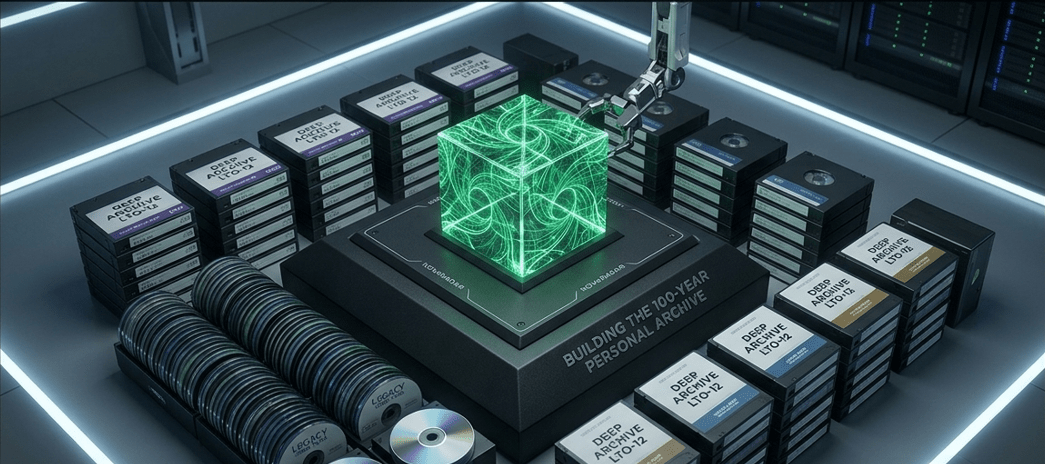
Have you ever stopped to realize that your entire digital existence is essentially a precarious rental? In 2026, most people live under the comfortable delusion that “the cloud” is a mystical, eternal realm where their photos, documents, and memories are safe. But you and I know the truth: the cloud is just someone else’s computer, and that person can decide to close your account, hike the prices, or go bankrupt at any moment.
We are entering the era of Data Hoarding 2.0. This isn’t about hoarding terabytes of trash on cheap hard drives that will click-of-death in five years. This is about sovereignty. It’s about building a 100-Year Personal Archive. A digital legacy that doesn’t depend on subscriptions, constant electricity, or the benevolence of Big Tech. If you want your “digital self” to survive the 21st century, Crystal Storage isn’t a luxury—it’s a basic survival necessity for the modern age.
1. The Anatomy of the Digital Dark Age
The grand irony of our era is that we are the most documented generation in history, yet we are storing our lives on the most fragile mediums ever created. Think about it. A 2,000-year-old parchment found in a cave can still be read today. A stone tablet from Sumeria remains legible after five millennia. But a file on a 30-year-old floppy disk? It’s a ghost. A hard drive from 2010? It’s a gamble.
Standard storage technology is plagued by “Bit Rot”—the silent killer of data. If you leave an HDD (Hard Disk Drive) in a box, the magnetic fields holding your data weaken over time. If you store an SSD or a USB drive, the electrical charge that retains the information eventually leaks out. This phenomenon, known as electron tunneling, means that in less than a decade, your drive becomes an expensive paperweight. In the context of a 100-Year Personal Archive, current consumer hardware is a systematic failure. We need something that treats data like stone, not like a fading echo in a silicon valley server.
2. The Science of 5D Crystal Storage: Data Etched in Eternity
The crown jewel of long-term archiving in 2026 is 5D Optical Data Storage, widely known as Crystal Storage. This isn’t science fiction; it is the culmination of decades of laser physics. Using femtosecond lasers, data is etched into quartz glass in five dimensions: the three spatial coordinates (X, Y, Z) and two optical dimensions (slow axis orientation and strength of retardation).
These tiny structures, called voxels, change the way light travels through the glass. Unlike any other medium, quartz crystal is immune to electromagnetic pulses (EMP), can withstand temperatures up to 1,000 degrees Celsius, and does not suffer from chemical degradation. We are talking about an estimated lifespan of 10,000 to 1 billion years. For a 100-Year Personal Archive, this is the gold standard. When you etch your knowledge base today, your great-grandchildren will be able to read it without needing to “repair” or “bit-check” the files. It is the ultimate victory of matter over obsolescence.
Comparison: Archival Technologies for the 2026 Sovereign Individua
To build a proper archive, you need to understand where to put your money. Here is the breakdown of the current landscape.
| Technology | Estimated Lifespan | Data Density | Best Use Case |
|---|---|---|---|
| Standard NVMe SSD | 5 – 10 Years | High | Daily OS & Projects |
| LTO-9 Tape | 30 – 50 Years | Ultra High | Massive Backups |
| M-DISC (Optical) | 1,000 Years | Moderate | Personal Legacy |
| Crystal Storage (5D) | 10,000+ Years | Extreme | Immutable Core |
3. The Archival Tiering Strategy: Why 3-2-1 is Obsolete
For decades, the “3-2-1 Backup Rule” (3 copies, 2 different media, 1 offsite) was the holy grail of data protection. In 2026, for a 100-Year Personal Archive, that rule is simply the bare minimum. We are now moving toward the Permanent Core Strategy.
The Permanent Core doesn’t just ask “is it backed up?” It asks “is it readable in a post-software world?” If your backup is stored in a proprietary format that requires a subscription to a cloud service that might not exist in twenty years, your data is already dead. True Data Hoarding 2.0 requires a shift to “Cold, Immutable, and Open” storage. You need a tier of data that is physically disconnected from the internet (Air-gapped) and stored in a medium that requires no power to maintain its integrity. This is where Crystal Storage and M-DISC come into play. They are the bedrock of your digital cathedral.
4. Hardware for the Modern Archivist: LTO-9 vs. M-DISC
While we wait for consumer-grade Crystal Storage writers to become as common as inkjet printers, the 2026 archivist uses a hybrid approach.
For the “heavy lifting”—your 4K raw video footage, your massive local LLM datasets, and your entire lossless music library—LTO-9 Tape remains the king of the cold archive. It is a magnetic tape technology that, if stored in a climate-controlled environment, will last 30 to 50 years. It is remarkably cheap per terabyte, making it the only viable option for those hoarding 100TB+ of data.
However, for your “Essential Core”—your private keys, your family ancestry, your legal documents, and your Sovereign AI PKM database—M-DISC is the current practical hero. Unlike standard DVDs or Blu-rays that use an organic dye layer (which rots over time), the M-DISC uses an inorganic, “rock-like” layer. A laser literally carves the data into a physical material. It is the most accessible way today to start your 100-Year Personal Archive without a million-dollar laboratory budget.
5. The Philosophy of Selection: What Deserves to Live Forever?
One of the biggest traps in Data Hoarding 2.0 is the “everything” fallacy. Just because you can store 50,000 blurry photos of your lunch doesn’t mean you should. A true archive is an act of curation. It is a gift you give to your future self and your descendants.
Curation is an act of love. It requires you to sit down and ask: “If I could only save 1% of my digital life, what would it be?” This process is deeply connected to overcoming AI Burnout. By focusing on what is truly meaningful—your original thoughts, your unique experiences, and your personal data—you stop being a passive consumer of digital noise and start being an architect of your own memory. Your archive should be a reflection of your soul, not a dumpster for the internet’s garbage.
6. Beyond Files: The Architecture of Immutable Formats
Creating a 100-Year Personal Archive isn’t just about the physical medium; it’s about the language your data speaks. In 2026, many people make the mistake of archiving data in proprietary formats. If you save your life’s work in a specific CAD format or a subscription-based document type, you are banking on that software company existing in 2100. History suggests they won’t.
To ensure your archive remains readable, you must adopt the “Plain Text First” philosophy. For documents, this means PDF/A (the archival version of PDF) or, ideally, Markdown. Markdown is just plain text with simple formatting; it can be read by any computer built in the last 40 years and likely any built in the next 100. For data structures, JSON or CSV are the gold standards. Avoid “binary black boxes” at all costs. Your 100-Year Personal Archive should be accessible to a human with a simple text editor, even if every modern AI tool vanished tomorrow.
7. The Faraday Shield: Protecting Your Legacy from Solar Flares and EMPs
In the world of Data Hoarding 2.0, we don’t just worry about hackers; we worry about physics. As we move deeper into 2026, the risk of extreme solar activity or man-made electromagnetic pulses (EMPs) is a conversation no longer relegated to “prepper” forums. If your only copy of your legacy is on a standard hard drive sitting on a shelf, one strong electromagnetic event could wipe it clean.
This is why the “Eternal Layer” of your archive—the Crystal Storage and M-DISCs—should be stored in a Faraday Cage. You don’t need a high-tech bunker; a specialized, shielded conductive box or even a properly grounded metal container can protect your physical media from stray currents. This is the ultimate “Air-Gap.” It isn’t just disconnected from the internet; it’s shielded from the atmosphere itself. This level of protection is what separates a hobbyist from a Sovereign Archivist.
8. Integrating the Archive with your Sovereign AI PKM
Now, let’s talk about the 2026 workflow. Your archive shouldn’t be a “black hole” where data goes to be forgotten. Thanks to the rise of Small Language Models (SLMs), your 100-Year Personal Archive can be alive. By using local tools like Ollama or specialized indexing agents, you can point an AI at your cold storage.
Imagine an AI that has been trained on your personal “Eternal Layer”—your journals from ten years ago, your research papers, and your family’s history. Because the storage is local and sovereign, you don’t have to worry about a cloud provider “learning” from your private life. Your AI becomes the librarian of your legacy. It can find connections between a thought you had in 2024 and a project you are starting in 2026. This synergy between ancient-durability (Crystal) and future-intelligence (AI) is the pinnacle of the NovaRadar philosophy.
9. The Cold Storage Protocol: Verification and Parity
Even with Crystal Storage, a pro-level 100-Year Personal Archive requires a maintenance protocol. We call this “Data Scrubbing.” Once a year, you should perform a checksum verification. This is where tools like ZFS or simple SHA-256 manifests come in.
A manifest is a small text file that lists every file in your archive and its unique “digital fingerprint.” If even a single bit flips due to cosmic rays (yes, that happens), the fingerprint changes. By using “Parity Files” (Parchive or PAR2), you can actually reconstruct corrupted data from thin air using mathematical redundancy. This is the “self-healing” aspect of Data Hoarding 2.0. You aren’t just hoping the data is there; you are mathematically ensuring its integrity.
10. The Ethics of the Archive: Digital Inheritance and the 100-Year Personal Archive
Who gets the keys to your 100-Year Personal Archive when you are no longer here to manage it? This is the most “human” and often overlooked aspect of the 100-Year Personal Archive philosophy. In 2026, we are witnessing the first wave of “Digital Estates” failing because encryption keys were lost or accounts were locked behind two-factor authentication tied to a deactivated phone number. A 100-Year Personal Archive is useless if it remains a locked black box for your heirs.
A truly sovereign 100-Year Personal Archive requires a physical “Dead Man’s Switch.” This isn’t just about technical redundancy; it’s about ensuring the continuity of your 100-Year Personal Archive. This could involve storing a physical M-DISC with master passwords and decryption protocols in a secure location or with a trusted legal representative. Remember, your legacy is only as good as its accessibility. If you lock your 100-Year Personal Archive behind a 64-character key that only you know, you haven’t built a legacy—you’ve built a digital tomb. To make your 100-Year Personal Archive successful, you must plan for its survival beyond your own.
11. Final Verdict: Your 2026 Stack for a 100-Year Personal Archive
Building a 100-Year Personal Archive is a marathon of sovereignty, not a quick sprint. You don’t need to purchase an industrial crystal engraver tomorrow, but you do need to stop trusting the ephemeral cloud with the “soul” of your data. The transition to a 100-Year Personal Archive is about shifting from a consumer mindset to a curator mindset.
The NovaRadar Recommended Stack for a 100-Year Personal Archive:
- Daily Operations: RAID-1 NVMe SSDs for high-speed local redundancy, ensuring your 100-Year Personal Archive stays updated in real-time.
- Monthly Resilience: A 20TB+ NAS using the ZFS file system to protect the growing body of your 100-Year Personal Archive against bit rot.
- The Eternal Core: M-DISC technology for the most essential personal files, forming the indestructible heart of your 100-Year Personal Archive.
- The Future Leap: Keep a close eye on consumer-grade Crystal Storage services to eventually house your entire Master Knowledge Base within your 100-Year Personal Archive.
Stop renting your memory from corporations that don’t care about your future. Stop letting Big Tech decide which parts of your life are worth keeping. Start your Data Hoarding 2.0 journey today by committing to a 100-Year Personal Archive and ensure that your unique digital voice echoes clearly into the next century.