
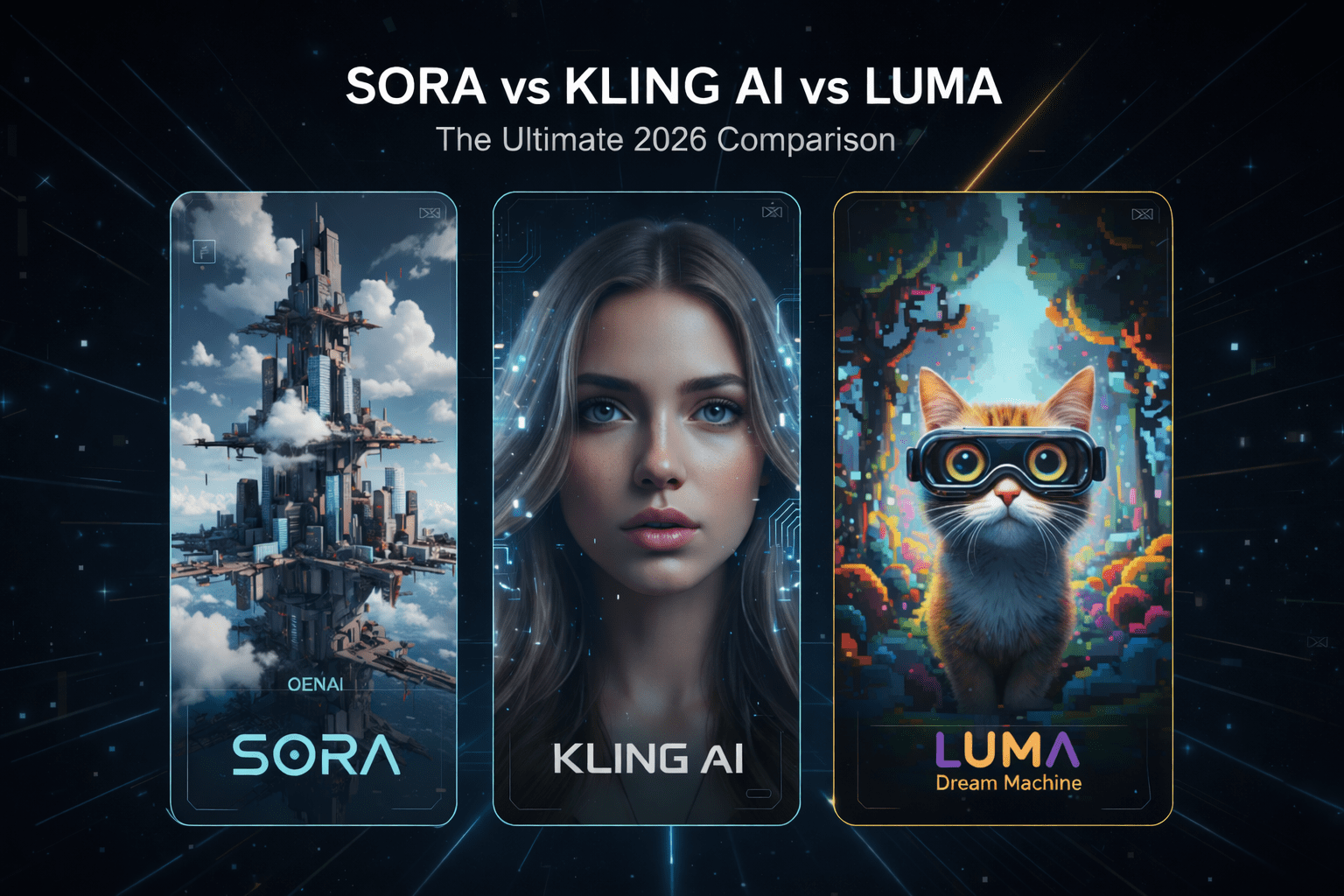
The visual storytelling landscape has been completely redefined in 2026. The arrival of hyper-realistic models has turned the “text-to-video” dream into a daily reality for millions of creators. Currently, the industry is dominated by three giants, and the Sora vs Kling AI vs Luma debate is the most discussed topic in digital production circles.
Choosing the best AI video generator is no longer just about who creates the prettiest picture. It is about physics, temporal consistency, and prompt adherence. In this Sora vs Kling AI vs Luma analysis, we will break down which tool actually delivers professional-grade results and which one is better suited for social media or rapid prototyping.
The State of AI Video in 2026
We have moved past the era of “distorted faces” and “spaghetti fingers.” In 2026, AI video is indistinguishable from reality in many cases. However, each company has taken a different path. While OpenAI focuses on world simulation, Kling AI has mastered hyper-realism, and Luma Dream Machine has become the favorite for its sheer speed and accessibility.
Sora (OpenAI): The World Simulator
Sora remains the most mysterious and powerful contender in the Sora vs Kling AI vs Luma triangle. Developed by OpenAI, its main strength is its understanding of physical laws. If you tell Sora to break a glass, it understands how the shards should fly. It doesn’t just “draw” video; it simulates a 3D environment and records it.
Kling AI: The New Realism King
Coming from China but with a global footprint in 2026, Kling AI surprised everyone by offering 2-minute long clips with almost zero “morphing.” In the Sora vs Kling AI vs Luma rivalry, Kling is often cited as the tool that produces the most “human” and cinematic textures, especially in skin and hair rendering.
Luma Dream Machine: Speed and Soul
Luma has positioned itself as the “creator’s friend.” It is fast, intuitive, and offers a level of artistic “soul” that others sometimes lack. In many Sora vs Kling AI vs Luma discussions, Luma is praised for its ability to take a single image and turn it into a dynamic, emotional scene in under 120 seconds.
Comparison Table: 2026 Video Titans
| Feature | Sora (OpenAI) | Kling AI | Luma Dream Machine |
|---|---|---|---|
| Max Length | Up to 60 Seconds | 10-20 Sec (Extendable) | 5-10 Seconds |
| Physics Engine | Elite / Stable Scenes | Very High / Fluid | Moderate / Dynamic |
| Primary Use | Cinematic Storytelling | Hyper-Realism | Speed & Socials |
| Access Type | Gated / API Focused | Public Web Interface | Public / Mobile App |
Technical Deep Dive: Physics vs. Esthetics
When analyzing Sora vs Kling AI vs Luma, we have to talk about temporal consistency. This is the ability of the AI to remember that a character is wearing a hat even if the camera moves.
- Sora’s Consistency: Sora is the champion here. Its architecture allows for complex camera movements (drones, pans) without the environment melting. In a Sora vs Kling AI vs Luma benchmark, Sora wins in long-form coherence.
- Kling’s Textures: Kling focuses on the “look.” The lighting in Kling AI videos feels like it was handled by a Hollywood DP. This makes the Sora vs Kling AI vs Luma choice difficult for those doing commercial fashion or food ads.
- Luma’s Creativity: Luma’s “Dream Machine” model often takes creative risks that result in more visually interesting (if slightly less “logical”) shots. It’s a key part of any professional automated AI workflow where rapid ideation is required.
The Cost of Creativity in 2026
The pricing structures in the Sora vs Kling AI vs Luma ecosystem are quite different. While OpenAI tends to bundle Sora within its enterprise or “Pro” tiers, Kling and Luma operate on credit-based systems.
- Sora: Expected to be the most expensive due to the massive compute power required.
- Kling AI: Offers a “Daily Free Credit” model that has made it extremely popular among independent creators in the Sora vs Kling AI vs Luma wars.
- Luma: Very competitive pricing, often being the most affordable way to generate high-quality video without a massive subscription. According to Forbes, the drop in AI compute costs is making these tools accessible to small businesses.
Use Cases: Who Should Use What?
The Sora vs Kling AI vs Luma debate isn’t about finding a single winner, but the right tool for the job:
- Choose Sora if: You are working on a short film or a project that requires a consistent world and complex physics.
- Choose Kling AI if: You need hyper-realistic people, close-ups of faces, or “perfect” lighting for high-end commercials.
- Choose Luma if: you are a social media manager or a YouTuber who needs 5-second “B-roll” clips quickly and with high artistic flair.
Security and Ethics: The Deepfake Problem
In 2026, the Sora vs Kling AI vs Luma competition is also a race for safety. OpenAI has implemented the most rigorous watermarking (C2PA) and safety filters. Kling and Luma have also added “human-in-the-loop” monitoring to prevent the creation of non-consensual imagery or political misinformation. Before choosing your best AI video generator, always check their ethical guidelines and data usage policies.
Frequently Asked Questions (FAQ)
Can I generate sound with Sora vs Kling AI vs Luma?
As of 2026, Sora has native sound generation (foley). Kling and Luma are catching up, often requiring third-party tools like ElevenLabs or Udio to complete the cinematic experience.
Which is easier for beginners: Sora vs Kling AI vs Luma?
Luma Dream Machine is widely considered the most “beginner-friendly” due to its simple interface and “Extend Video” feature.
Do I need a powerful computer to run Sora vs Kling AI vs Luma?
No. All three are cloud-based. You can generate a 4K cinematic masterpiece on an old laptop or even a smartphone, as the heavy lifting is done in the companies’ data centers.
Final Thoughts: The Winner of the 2026 Battle
The Sora vs Kling AI vs Luma showdown has a clear winner: the creator. Never in history has the barrier to entry for high-quality cinematography been so low. Whether you prefer the physical accuracy of Sora, the realism of Kling, or the speed of Luma, the future of video is already here.
For more deep dives into the tools shaping our world, check out our comparison of Fireflies.ai vs Otter.ai and stay at the forefront of the AI revolution.