
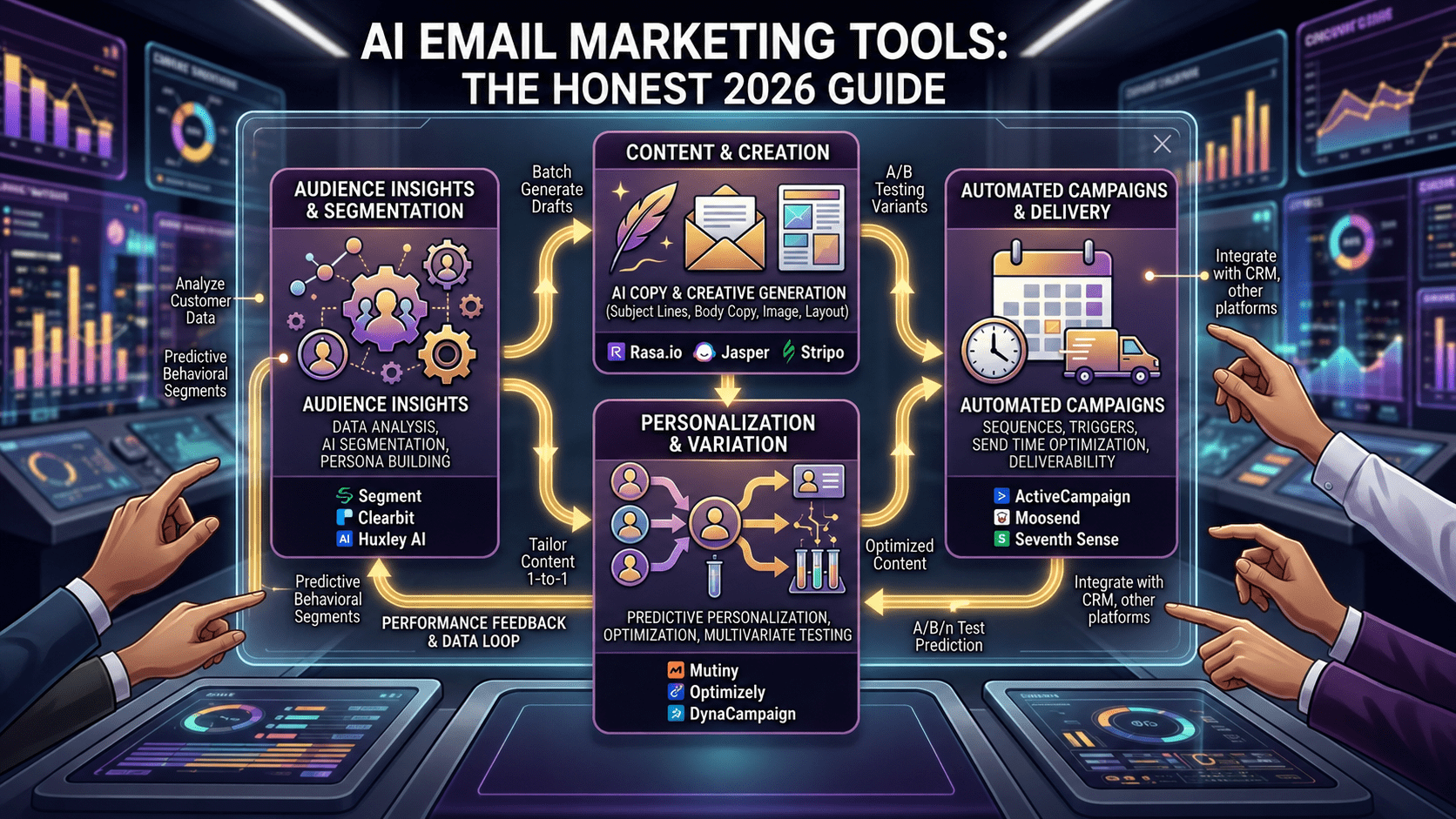
Email marketing has always been one of the highest-ROI channels available to businesses and creators. But in 2026, the gap between teams using AI email marketing tools and those still writing every campaign manually has become almost impossible to close without making the switch. The volume of personalization, testing, and optimization that AI enables simply can’t be replicated at human speed.
This guide covers the AI email marketing tools that are actually worth your time and money — not the ones with the biggest marketing budgets or the most impressive landing pages, but the ones that produce real results when you put them inside a real workflow. We’ve tested each one across multiple use cases, and the honest verdict is below.
Why AI Email Marketing Tools Changed Everything in 2026
For a long time, email marketing improvements were incremental. Better subject line testing here, a smarter send-time algorithm there. The core workflow — write campaign, build list, send, analyze — stayed essentially the same for over a decade.
AI email marketing tools broke that pattern completely. The shift happened on three fronts simultaneously: content generation, personalization at scale, and predictive analytics. Where it used to take a copywriter half a day to produce three subject line variations and a full email body, AI email marketing tools now generate twenty variations in minutes, test them automatically, and surface the winner before a human has finished their first draft.
The personalization angle is even more significant. Traditional email marketing personalization meant inserting a first name and maybe a company name. Modern AI email marketing tools analyze individual subscriber behavior — open history, click patterns, purchase timing, engagement recency — and generate genuinely different content for different segments without manual segmentation work from your team.
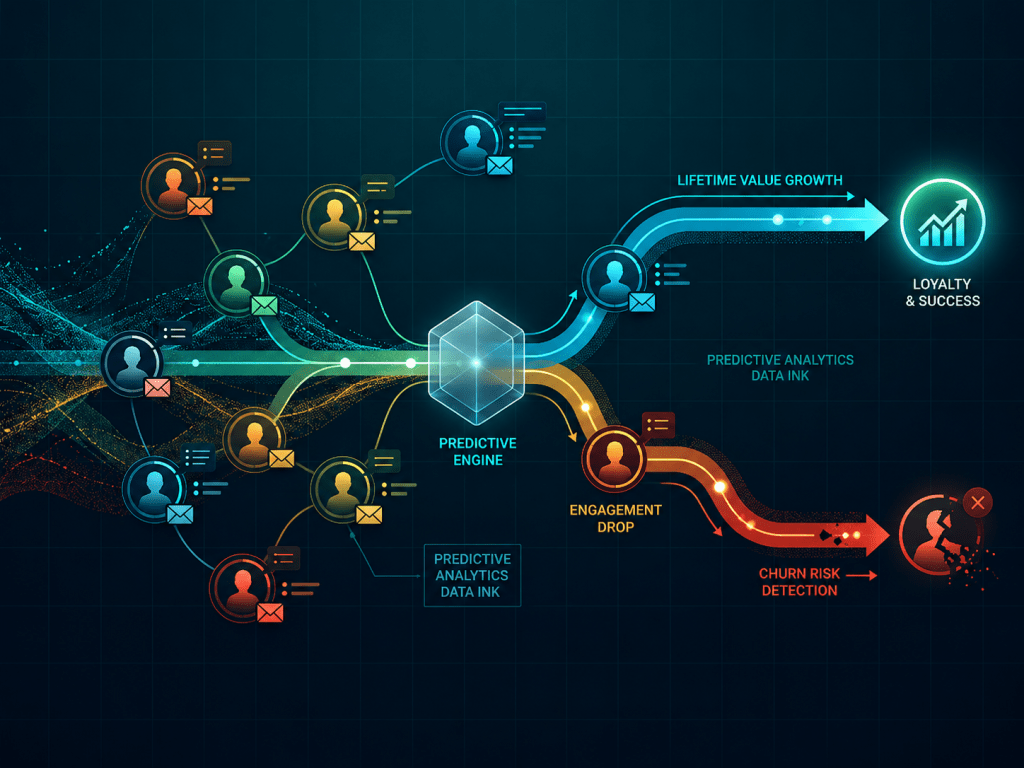
And on the analytics side, AI email marketing tools now predict which subscribers are likely to churn before they unsubscribe, which campaigns are likely to underperform before they send, and which list segments are most likely to convert on a given offer. That predictive layer turns email from a reactive channel into a proactive one.
For context on how AI email marketing tools fit into a broader AI stack for business, the guide on best AI tools for productivity 2026 covers how these tools connect to the wider workflow picture.
The Main AI Email Marketing Tools Worth Knowing in 2026
The market for AI email marketing tools has consolidated significantly over the past two years. A few clear leaders have emerged, each with a distinct positioning and a different set of strengths. Here’s an honest breakdown of the platforms that consistently come up in real conversations with marketing teams and solo operators.
Klaviyo has become the dominant AI email marketing tools platform for ecommerce brands. Its predictive analytics — churn probability, lifetime value forecasting, next purchase date — are genuinely best-in-class, and its AI-powered segmentation is the most sophisticated available without enterprise pricing. The writing assistance features are solid but not the main reason people choose it. The main reason is the data layer, which is deeper than anything else in this price range.
Mailchimp has reinvented itself significantly with AI features that make it one of the most accessible AI email marketing tools for small businesses and solo creators. Its Content Optimizer analyzes your email copy and suggests improvements based on engagement data from billions of emails. Its Creative Assistant generates on-brand designs automatically. And its send-time optimization has improved enough to be genuinely useful rather than just a checkbox feature.
ActiveCampaign sits between Klaviyo and Mailchimp in terms of complexity and price, and it’s consistently one of the most recommended AI email marketing tools for businesses that need serious automation without full ecommerce integration. Its AI features focus primarily on automation building — predicting the best automation paths for individual subscribers based on behavior — and its CRM integration is the strongest of the three platforms covered here.
Instantly and Smartlead are worth mentioning separately as AI email marketing tools built specifically for cold outreach rather than list-based marketing. Both use AI to personalize cold emails at scale, manage sending infrastructure to avoid spam filters, and optimize sequences based on reply rates. If cold email is part of your growth strategy, these two are significantly ahead of anything the general-purpose platforms offer for that specific use case.
For a broader look at how these platforms compare to other AI business tools, the guide on best AI agents for business 2026 provides useful context on where email automation fits within a full AI-powered business operation.
How to Actually Use AI Email Marketing Tools Effectively
Knowing which AI email marketing tools to use is only half the picture. Knowing how to use them effectively is where most teams fall short — and where the real competitive advantage lives.
The most common mistake with AI email marketing tools is treating the AI as a replacement for strategy rather than an accelerant of it. AI can generate subject lines, but it can’t tell you what your audience fundamentally needs to hear right now. AI can personalize content, but it can’t define your brand voice. AI can optimize send times, but it can’t decide what offer to make in the first place. Those strategic decisions still require human judgment, and they’re the decisions that determine whether the AI-generated execution actually works.
The second most common mistake is not feeding the AI enough data. Every AI email marketing tools platform performs significantly better with more behavioral data to work from. If you’re starting with a fresh list or a platform you just migrated to, give the AI at least four to six weeks of real send data before trusting its optimization recommendations. The predictions get meaningfully more accurate as the behavioral dataset grows.
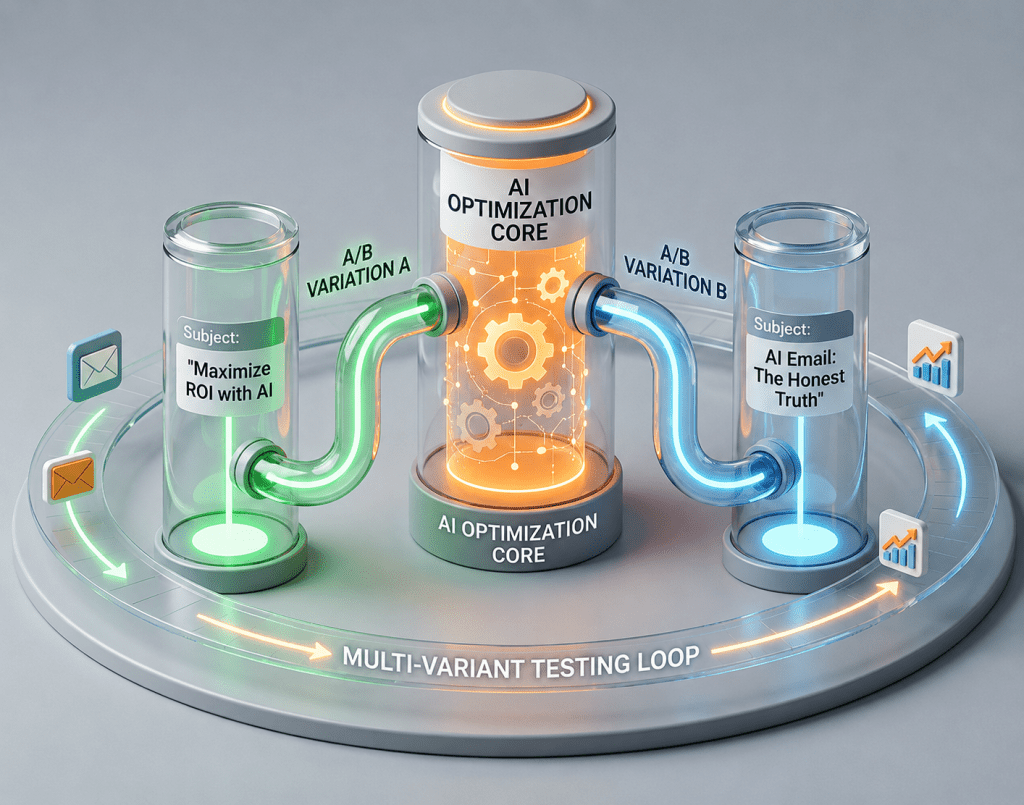
The third mistake is ignoring the testing infrastructure that AI email marketing tools make available. Most platforms now support multivariate testing — testing subject lines, preview text, send times, content blocks, and CTAs simultaneously rather than one variable at a time. Most teams still test one variable per campaign because that’s what they did before AI. The whole point of AI email marketing tools is that they can handle the complexity of multivariate testing automatically. Use that capability from day one.
For teams building automated email sequences specifically, the guide on how to automate your inbox with AI agents covers the agent-based approach to email automation in detail — a useful complement to platform-native AI features.
Comparison Table: AI Email Marketing Tools Side by Side
| Feature | Klaviyo | Mailchimp | ActiveCampaign |
|---|---|---|---|
| AI Content Generation | ⭐⭐⭐ | ⭐⭐⭐⭐ | ⭐⭐⭐ |
| Predictive Analytics | ⭐⭐⭐⭐⭐ | ⭐⭐⭐ | ⭐⭐⭐⭐ |
| Automation Builder | ⭐⭐⭐⭐ | ⭐⭐⭐ | ⭐⭐⭐⭐⭐ |
| Personalization Depth | ⭐⭐⭐⭐⭐ | ⭐⭐⭐ | ⭐⭐⭐⭐ |
| Ease of Use | ⭐⭐⭐ | ⭐⭐⭐⭐⭐ | ⭐⭐⭐⭐ |
| Value for Money | ⭐⭐⭐ | ⭐⭐⭐⭐ | ⭐⭐⭐⭐ |
| Best For | Ecommerce | Small Business | B2B & SaaS |
| Starting Price | ~$45/mo | ~$13/mo | ~$29/mo |
What Good AI Email Marketing Tools Actually Optimize For
One of the most useful things to understand about AI email marketing tools is what they’re actually optimizing for under the hood — because it’s not always what the marketing material suggests.
Most AI email marketing tools optimize primarily for open rates and click rates because those are the metrics they can measure directly and quickly. That’s useful, but it means the AI can sometimes push you toward subject lines and content that perform well on those metrics while undermining deeper goals like brand trust, long-term engagement, and actual conversion.
The best teams using AI email marketing tools are aware of this dynamic and add a human review layer specifically for brand alignment. The AI generates the highest-performing version according to its training data. A human checks whether that version actually sounds like the brand and serves the long-term relationship with the subscriber. That combination — AI optimization plus human brand judgment — consistently outperforms either approach alone.
There’s also the deliverability dimension, which AI email marketing tools are increasingly factoring into their recommendations but which still requires active management from your side. Sending frequency, list hygiene, engagement-based segmentation, and authentication setup all affect whether your emails reach the inbox at all. The most sophisticated AI email marketing tools now flag deliverability risks before you send, but acting on those flags requires understanding what they mean. Mailchimp’s email marketing benchmarks and Litmus’s email deliverability guide are two of the most reliable external references for keeping deliverability strong.
Pricing Reality Check for AI Email Marketing Tools
Pricing for AI email marketing tools is almost universally tied to list size, which means the cost at scale can be significantly higher than entry-level pricing suggests. Here’s what to actually expect across the main platforms.
Klaviyo’s pricing starts at around $45/month for up to 1,000 contacts with email only, but scales to $400/month or more at 25,000 contacts. For ecommerce brands where the predictive analytics and deep personalization genuinely drive revenue, that cost is usually justified. For brands without a strong ecommerce data layer to feed the AI, the premium over simpler AI email marketing tools is harder to justify.
Mailchimp’s pricing starts at $13/month for basic features and scales more gradually, making it one of the most accessible AI email marketing tools for teams with smaller lists or tighter budgets. The AI features at the entry tier are more limited, but the core content optimization and send-time features are available across most paid plans.
ActiveCampaign starts at $29/month and scales based on both contacts and features. Its automation builder — arguably the strongest of any AI email marketing tools platform in this price range — is available from the entry tier, which makes it unusually good value for teams that need serious automation from day one.
All three platforms offer free trials or free tiers with meaningful limitations. Running a real campaign test on each before committing is worth the setup time — platform fit is personal enough that benchmarks and reviews only get you so far.
How AI Email Marketing Tools Fit Into a Broader Business Automation Stack
AI email marketing tools rarely operate in isolation. In most mature business setups, email is one node in a larger automation graph that includes CRM, customer support, social media, and analytics. Understanding how AI email marketing tools connect to the rest of that stack is increasingly important for getting full value from them.
On the CRM side, Klaviyo integrates deeply with Shopify and most major ecommerce platforms. ActiveCampaign has its own built-in CRM that’s strong enough for most B2B use cases. Mailchimp integrates broadly but less deeply than either. The quality of the CRM integration determines how much behavioral data the AI has to work with — and as we covered earlier, more data means meaningfully better AI performance over time.
On the automation side, connecting AI email marketing tools to broader workflow automation platforms like Make or Zapier unlocks significant additional capability. Triggering email sequences based on events in other tools — a deal closing in your CRM, a form submission on your website, a specific action in your product — is where AI email marketing tools become genuinely powerful rather than just efficient. The guide on n8n vs Make vs Zapier 2026 covers how to choose the right automation platform for connecting these tools.

For teams building more sophisticated multi-agent AI systems that include email as one component, the guide on how to build a multi-agent AI system for business covers the architecture and practical setup in detail.
Common Mistakes People Make With AI Email Marketing Tools
Even with the best AI email marketing tools in place, a handful of recurring mistakes consistently undermine results across teams of all sizes.
Over-relying on AI-generated subject lines without testing is the first. AI subject line generators are useful starting points, but they’re trained on aggregate data that may not reflect your specific audience. Test every AI-generated subject line against a human-written alternative until you have enough data to know whether the AI’s recommendations outperform yours for your specific list.
Ignoring list hygiene is the second. AI email marketing tools can’t fix a list full of disengaged subscribers — they can only optimize delivery to whatever list you give them. Regular list cleaning, re-engagement campaigns, and sunset policies for inactive subscribers are as important in an AI-powered workflow as they were in a manual one. Validity’s email deliverability research is one of the most authoritative external sources on this topic.
Treating automation as a set-and-forget system is the third. AI email marketing tools make automation dramatically easier to build, which leads many teams to build complex sequences and never revisit them. Automation sequences need regular auditing — checking whether the triggers still make sense, whether the content is still relevant, and whether the performance benchmarks are being met. Set a calendar reminder to audit every active sequence at least once per quarter.
Not connecting email performance to revenue is the fourth. Most AI email marketing tools show opens and clicks by default, but the metric that actually matters for most businesses is attributed revenue. Make sure your email platform is connected to your ecommerce or analytics system so you can see which campaigns and sequences are actually driving business outcomes — not just engagement.
Who Should Use Which AI Email Marketing Tools
Choosing between AI email marketing tools comes down to your business model, technical comfort level, and the specific AI features that matter most for your use case.
Choose Klaviyo if you run an ecommerce business with meaningful transaction data, need the most sophisticated predictive analytics available at non-enterprise pricing, and are willing to invest time in learning a more complex platform to access those capabilities.
Choose Mailchimp if you’re a small business, solo creator, or nonprofit that needs accessible AI email marketing tools with a gentle learning curve, strong design assistance, and reliable core features at a price point that scales gradually.
Choose ActiveCampaign if you’re a B2B business, SaaS company, or service business that needs powerful automation, a built-in CRM, and AI that focuses on optimizing subscriber journeys rather than ecommerce-specific metrics.
Choose Instantly or Smartlead if cold email outreach is your primary use case and you need AI email marketing tools built specifically for deliverability management, personalization at scale, and sequence optimization based on reply rates rather than open rates.
For teams still building their overall AI tool stack and trying to understand where email fits in the bigger picture, the guide on essential AI software 2026 provides a useful framework for thinking about tool selection across categories.
Final Thoughts on AI Email Marketing Tools
AI email marketing tools have fundamentally changed what’s possible for businesses and creators of every size. The personalization, testing, and optimization capabilities that used to require enterprise budgets and dedicated data science teams are now accessible at price points that make sense for small teams and solo operators.
But the tools are only as good as the strategy behind them. AI email marketing tools amplify what you already do — which means they amplify good strategy and bad strategy with equal efficiency. The teams getting the most from AI email marketing tools in 2026 are not the ones with the most sophisticated platforms. They’re the ones with clear audience understanding, consistent brand voice, disciplined testing habits, and the patience to let the AI’s data layer mature before trusting its recommendations fully.
Start with the platform that fits your current business model and budget. Run real campaigns. Feed the AI real data. Test more than you think you need to. And treat the human layer — the strategic decisions, the brand voice, the relationship-building judgment — as the irreplaceable complement to everything the AI email marketing tools handle automatically.
That’s the combination that actually drives results in 2026. Not the tool alone, and not the human alone — but both, working together in a system that improves every time you run it.