

The online education market has exploded over the past few years, and AI course creation platforms have been at the center of that explosion. What used to take weeks of manual work — structuring a curriculum, writing lesson scripts, building assessments, designing landing pages — now takes days or even hours with the right platform and the right AI features behind it.
But not all AI course creation platforms are built the same. Some are exceptional at helping you build and structure content. Others shine at marketing and selling that content. A few try to do everything and end up doing nothing brilliantly. Choosing the wrong one costs you not just money, but the kind of time you can’t get back once a course is built on the wrong foundation.
This comparison covers the three AI course creation platforms that consistently come up in real conversations with educators, coaches, and content creators: Teachable, Thinkific, and Kajabi. We tested each one across a full course creation workflow — from curriculum planning to launch — and the honest verdict is below.
Why AI Course Creation Platforms Matter More Than Ever
Building an online course in 2026 without using AI course creation platforms is like writing a book without a word processor. Technically possible, but unnecessarily slow and painful compared to what’s available.
The AI layer in modern AI course creation platforms touches every stage of the process. At the planning stage, AI helps you structure a curriculum based on your topic and target audience — identifying gaps, suggesting module sequences, and flagging content that’s likely to cause learner drop-off. At the content creation stage, AI generates lesson outlines, quiz questions, and even full lesson scripts that you refine rather than write from scratch. At the marketing stage, AI writes sales page copy, email sequences, and ad creative based on your course content and audience data.
The cumulative time saving across a full course build is significant. Creators who have built courses both before and after AI course creation platforms added serious AI features consistently report cutting their production time by forty to sixty percent — not by compromising quality, but by eliminating the blank-page problem at every stage of the process.
There’s also a quality dimension. AI course creation platforms with strong assessment tools can now analyze learner behavior — completion rates, quiz performance, re-watch patterns — and surface specific content that’s causing confusion or drop-off. That feedback loop was previously only available to well-funded course teams with dedicated instructional designers. Now it’s a standard feature in most serious AI course creation platforms.
For context on how AI course creation platforms fit into a broader AI productivity stack, the guide on best AI tools for productivity 2026 covers the wider picture well.
The Three Main AI Course Creation Platforms in 2026
Before diving into the head-to-head testing, here’s a clear-eyed introduction to each platform and what it’s actually built for — because understanding their positioning explains most of the differences in features and pricing.
Teachable is the most creator-focused of the three AI course creation platforms covered here. It started as a simple, accessible tool for individual educators and has evolved into a full platform with AI-powered curriculum builders, coaching product support, and a relatively clean interface that doesn’t overwhelm first-time course creators. Its AI features are genuinely useful rather than cosmetic, and its pricing is the most accessible of the three at the entry level.
Thinkific has positioned itself as the most business-forward of the AI course creation platforms in this comparison. Its AI tools focus heavily on learner engagement and course completion — which matters enormously for creators whose business model depends on transformation and outcomes rather than just content delivery. Its community features and analytics are the strongest of the three, and it has the most robust free tier of any serious AI course creation platforms on the market.
Kajabi is the all-in-one option. It’s not just one of the AI course creation platforms — it’s a complete business platform that includes email marketing, landing pages, pipelines, podcasting, community, and a website builder alongside the course creation tools. Its AI features span all of those areas rather than focusing purely on course production. The trade-off is price: Kajabi is significantly more expensive than the other AI course creation platforms covered here, and the complexity can feel overwhelming if all you need is to build and sell a course.
For a broader look at how AI tools compare across business automation use cases, the guide on best AI agents for business 2026 provides useful context on where course platforms fit within a full AI-powered business stack.
Head-to-Head Testing: AI Course Creation Platforms Under Real Conditions
Testing AI course creation platforms properly means going beyond the feature list and actually building something on each one. For this comparison, we ran each platform through the same task set: building a five-module course on a defined topic, from initial curriculum planning through to a published sales page with a checkout flow.
Curriculum planning was where the AI differences were most immediately apparent. Kajabi’s AI assistant produced the most structured initial curriculum outline, with clear learning objectives per module and suggested assessment types. Teachable’s AI curriculum builder was faster and more opinionated — it makes strong suggestions rather than asking many questions, which suits creators who want to move quickly. Thinkific’s approach was the most collaborative, generating multiple curriculum options based on different learner outcome priorities and letting you choose the direction before drilling down.
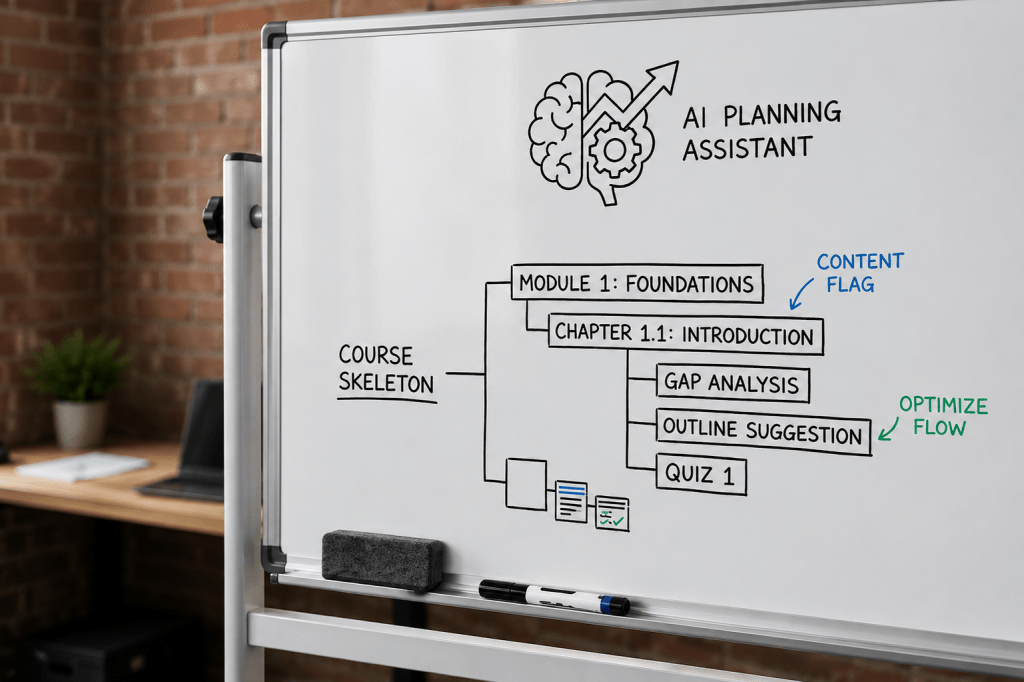
Content generation favored Teachable for speed and Kajabi for depth. Teachable’s lesson outline generator produced usable first drafts faster than either competitor. Kajabi’s AI went deeper — generating not just outlines but full lesson scripts, quiz questions, and supplementary resource suggestions for each module. Thinkific’s content AI was the most conservative of the three AI course creation platforms, generating solid structures but requiring more human input to reach a publishable standard.
Sales page and marketing copy is where Kajabi’s all-in-one approach pays off most clearly. Its AI generates sales page copy, email sequences, and even webinar scripts all from the same course content brief — a workflow that requires jumping between multiple tools on Teachable or Thinkific.

For creators who want AI course creation platforms to handle the full funnel, not just the course itself, Kajabi’s advantage here is meaningful.
Learner experience and analytics went to Thinkific. Its completion tracking, quiz analytics, and engagement heatmaps are the most detailed of any AI course creation platforms in this price range, and its AI-powered suggestions for improving completion rates are genuinely actionable rather than generic.

The guide on Llama 4 vs GPT-5 vs Claude 4 comparison provides useful context on the underlying AI models powering many of these platform features — relevant if you want to understand why different AI course creation platforms produce different quality outputs from similar prompts.
Comparison Table: AI Course Creation Platforms Side by Side
| Feature | Teachable | Thinkific | Kajabi |
|---|---|---|---|
| AI Curriculum Builder | ⭐⭐⭐⭐ | ⭐⭐⭐⭐ | ⭐⭐⭐⭐⭐ |
| Content Generation | ⭐⭐⭐⭐⭐ | ⭐⭐⭐ | ⭐⭐⭐⭐⭐ |
| Learner Analytics | ⭐⭐⭐ | ⭐⭐⭐⭐⭐ | ⭐⭐⭐⭐ |
| Marketing & Sales Tools | ⭐⭐⭐ | ⭐⭐⭐ | ⭐⭐⭐⭐⭐ |
| Ease of Use | ⭐⭐⭐⭐⭐ | ⭐⭐⭐⭐ | ⭐⭐⭐ |
| Value for Money | ⭐⭐⭐⭐⭐ | ⭐⭐⭐⭐ | ⭐⭐⭐ |
| Community Features | ⭐⭐⭐ | ⭐⭐⭐⭐⭐ | ⭐⭐⭐⭐ |
| Starting Price | ~$39/mo | Free / ~$36/mo | ~$149/mo |
Pricing Reality: What AI Course Creation Platforms Actually Cost at Scale
Pricing for AI course creation platforms is one of the most misunderstood aspects of the market, largely because entry-level pricing looks very different from what you actually pay once your course business grows.
Teachable’s entry plan starts at around $39/month with a transaction fee on sales. The transaction fee disappears on higher plans, which start at $119/month. For creators doing meaningful revenue, the higher plan pays for itself quickly — but it means Teachable’s true cost for a working course business is closer to $119/month than the headline entry price suggests. Its AI features are available across paid plans, making it one of the most accessible AI course creation platforms for getting started with AI-assisted course building without a large upfront investment.
Thinkific has the most generous free tier of any serious AI course creation platforms — you can actually publish and sell courses on the free plan with meaningful limitations. Paid plans start at around $36/month and scale to $149/month for the most feature-rich tier. The AI features are concentrated in the higher tiers, which is worth factoring into budget planning if AI-assisted curriculum building and analytics are priorities for your workflow.
Kajabi starts at $149/month and goes up to $399/month for the Growth plan where most serious course businesses operate. That pricing is significantly higher than the other AI course creation platforms covered here, but it replaces tools that would otherwise cost separately — email marketing platform, landing page builder, community platform, and podcast hosting all included. For businesses already paying for those tools, Kajabi can actually represent better total value than it appears at first glance.
All three AI course creation platforms offer annual billing discounts of roughly twenty percent, which is worth taking once you’ve validated the platform fit through a monthly trial period. Teachable’s pricing page, Thinkific’s pricing page, and Kajabi’s pricing page all publish current rates with feature breakdowns worth reviewing before committing.
Advanced AI Features Worth Knowing About
Beyond the core curriculum and content generation tools, the best AI course creation platforms in 2026 have added AI features that are less talked about but genuinely valuable for creators building course businesses at scale.
AI-powered pricing optimization is one of the most underused features available in Kajabi’s higher tiers. The system analyzes your audience behavior, conversion data, and comparable course pricing to suggest optimal price points and bundle configurations. For creators who struggle with pricing decisions — which is most creators — this removes significant guesswork from a decision that meaningfully affects revenue.
Automated learner re-engagement is now available across all three AI course creation platforms in various forms. When a learner stops progressing through a course, the AI triggers personalized re-engagement sequences based on where they dropped off and what content patterns predict successful completion. This feature alone can meaningfully improve completion rates, which matters both for learner outcomes and for testimonial and referral generation.
AI quiz and assessment generation has improved dramatically across AI course creation platforms in the past year. The current generation of assessment tools doesn’t just generate questions — it generates questions calibrated to specific learning objectives, with distractor options designed to surface specific misconceptions rather than just test recall. For educators who care about actual learning outcomes, this is a genuinely significant capability upgrade.
For creators interested in how AI tools can enhance their broader content and presentation workflow beyond course platforms, the guide on AI presentation tools 2026 covers the AI-powered slide and visual content tools that complement AI course creation platforms well.
Common Mistakes With AI Course Creation Platforms
Even with the best AI course creation platforms available, a handful of consistent mistakes undermine results for creators across every niche and experience level.
Treating AI curriculum suggestions as final is the most common. The AI in every platform on this list generates solid structural frameworks, but it doesn’t know your specific audience’s current knowledge level, their specific pain points, or the unique angle that makes your course worth buying over the dozens of alternatives on the same topic. AI generates the skeleton — you provide the expertise and the positioning that makes it worth purchasing.
Ignoring completion rate data is the second mistake. Every serious AI course creation platforms now surfaces completion analytics, and most creators look at them once and never again. Completion rate data is the most honest feedback your course will ever receive. Low completion at a specific module means the content isn’t working — the pacing is off, the explanation is unclear, or the learner expectation set earlier in the course doesn’t match what this module delivers. Fix it.
Launching on the wrong platform is the third and most costly mistake. Migrating a course from one of the AI course creation platforms to another after launch means rebuilding student access, transferring purchase records, and potentially disrupting the learner experience for existing students. Spend the time upfront to choose the right platform for your specific business model rather than defaulting to the most familiar or the cheapest option.
Not connecting the course to a broader content strategy is the fourth. The most successful creators using AI course creation platforms treat their course as one node in a larger content ecosystem — with free content feeding the funnel, community building trust, and email sequences nurturing leads over time. The guide on AI tools for social media growth 2026 covers how to build that broader ecosystem around a course product effectively.
External resources worth bookmarking for ongoing platform comparison and market context include Craig Campbell’s course platform reviews and Creator Economy Report by Kajabi — both reliable independent sources for tracking how AI course creation platforms evolve over time.
Who Should Use Which Platform
The right choice among AI course creation platforms depends almost entirely on your business model and where you are in your course creator journey.
Choose Teachable if you’re building your first course, prioritize ease of use over depth of features, and want the most accessible entry point into serious AI course creation platforms without a steep learning curve or a large monthly commitment.
Choose Thinkific if learner outcomes and completion rates are central to your business model — coaching programs, certification courses, corporate training — and you need the strongest analytics and community features available at a mid-range price point.
Choose Kajabi if you’re building a full course business rather than just a course, already paying for multiple separate tools that Kajabi would replace, and want AI course creation platforms that handle marketing, email, community, and content from a single dashboard without integration complexity.
For creators who want to understand how AI tools can support the research and content development process that feeds into course creation, the guide on autonomous AI research agents for business 2026 covers how AI research tools can dramatically accelerate the content development phase of any course build.
Final Thoughts on AI Course Creation Platforms
The best AI course creation platforms in 2026 have genuinely closed the gap between professional course production and what individual creators can achieve with limited time and resources. The AI features that used to require instructional design expertise and dedicated production teams are now built into the platforms themselves — accessible to anyone willing to learn how to use them properly.
But the fundamental truth about AI course creation platforms hasn’t changed: the AI amplifies the quality of what you bring to it. Strong subject matter expertise, genuine understanding of your audience, and clear positioning still determine whether a course succeeds or fails. The AI course creation platforms handle the production speed and optimization. You handle the substance and the strategy.
Start with a free trial on whichever platform matches your current business model. Build one full module — not just explore the interface — before making a judgment about fit. Give the AI real content and real objectives to work with rather than placeholder text. That’s the honest path to knowing which of the AI course creation platforms actually works for your specific situation in 2026.
The window to build a course business with a real AI advantage is wide open right now. The creators who move first and build real systems around these tools will have a compounding advantage over those who wait until everyone is using them.