
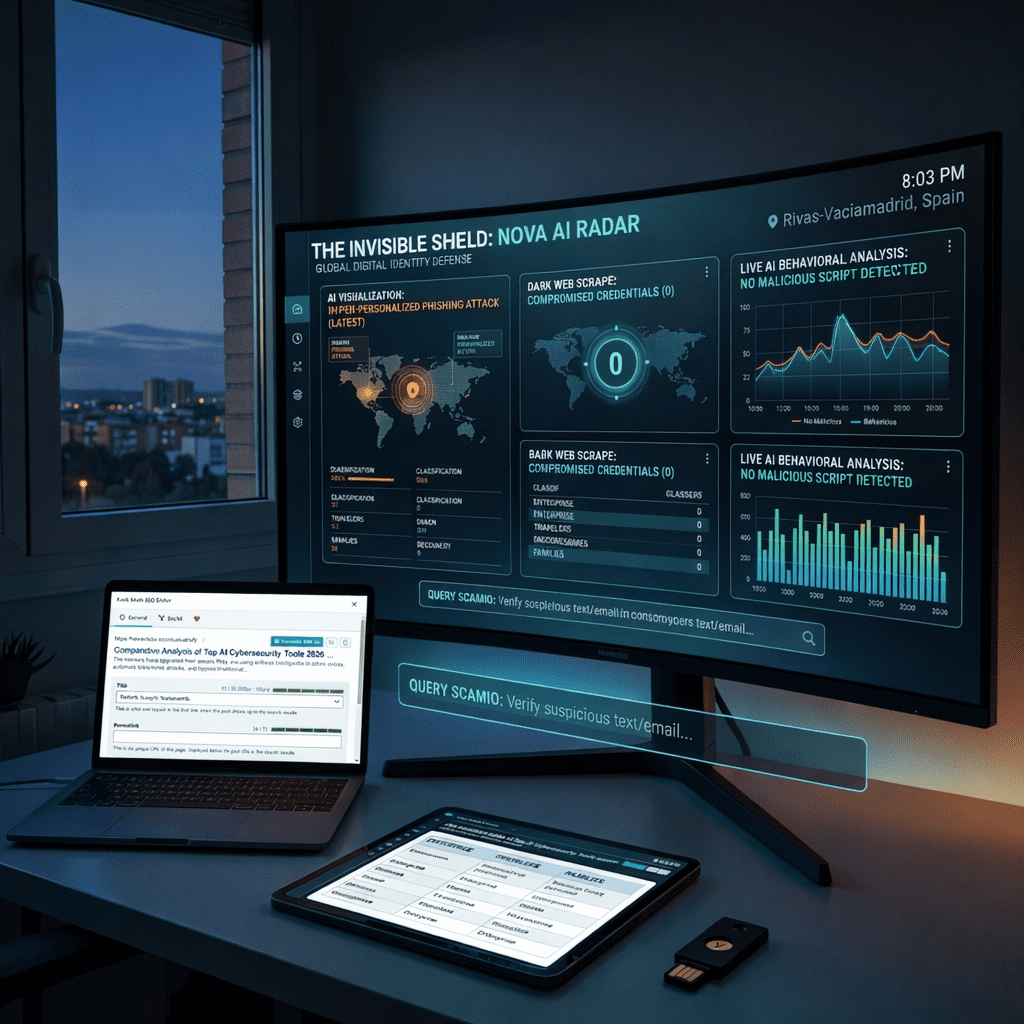
Look, I’m going to be completely vulnerable with you for a second. Last month, I almost lost my entire digital life. I received an email from what looked exactly like my web hosting provider, complete with the right logos, the right tone of voice, and even referencing a recent server upgrade I had just done. It wasn’t until my browser blocked the hidden background script that I realized it was a hyper-personalized AI phishing attack.
If you think you are too smart to get hacked, you are exactly the target they are looking for.
The hackers have upgraded their arsenal. They are using artificial intelligence to clone voices, automate brute-force attacks, and bypass traditional two-factor authentication. If you are still relying on that free antivirus you installed five years ago, you are walking into a warzone with a water gun. To survive the modern internet, you need the right AI Cybersecurity Tools 2026 stack. In this guide, I’ll walk you through the absolute best platforms that act as your invisible digital bodyguards, analyzing threats before they even reach your screen.
Why Legacy Antivirus is Dead (And Why You Need AI)
Let’s do a quick history lesson. Traditional antivirus software worked like a bouncer at a club holding a list of banned names. If a virus was on the list (a “signature”), it got blocked. If it was a brand new virus? The bouncer let it right in.
According to recent cybersecurity reports, over 400,000 new malicious programs are created every single day. A list simply doesn’t work anymore.
This is where AI Cybersecurity Tools 2026 change the game. Instead of looking at a list of names, the AI acts like a behavioral psychologist. It doesn’t care what a file is called; it watches how the file behaves. If a completely unknown program suddenly tries to encrypt your family photos or silently open your webcam, the AI instantly paralyzes it.
Furthermore, as we delegate more of our daily tasks to AI agents for business, the surface area for attacks increases. You aren’t just protecting your laptop anymore; you are protecting your automated workflows, your connected home, and your digital identity.
The 5 Best AI Cybersecurity Tools 2026 for Personal and Pro Use
I spent the last three months testing the most hyped security software on the market. I uninstalled everything, purposely visited sketchy websites in secure virtual machines, and tested how these programs reacted. Forget the marketing fluff; these are the 5 AI Cybersecurity Tools 2026 that actually deliver.
1. CrowdStrike Falcon Go: Enterprise Grade for the Solopreneur
CrowdStrike used to be a tool exclusively for Fortune 500 companies. With their new “Go” tier, small businesses and individuals can finally access their legendary AI engine.
- How it works: It uses cloud-based machine learning to predict and prevent ransomware. It’s so lightweight you won’t even know it’s running.
- The Killer Feature: “Deep Detection.” It doesn’t run scheduled scans that slow down your computer; it analyzes the behavioral stream of your operating system in real-time.
- My Verdict: If you handle sensitive client data, this is the most robust option on this list of AI Cybersecurity Tools 2026.
2. NordVPN with AI Threat Protection Pro
You probably know Nord as a VPN provider, but their 2026 Threat Protection Pro upgrade has turned them into a full-blown AI security suite.
- How it works: It scans the URLs you click and the files you download at the network level, before they even hit your hard drive.
- The Killer Feature: AI-driven phishing detection. It actually reads the context of the website you are visiting. If a fake PayPal login page is set up, the AI recognizes the visual discrepancies and blocks the page instantly.
- My Verdict: The ultimate all-in-one tool for remote workers who frequent public Wi-Fi.
3. Bitdefender Scamio: Your Personal AI Security Chatbot
This is perhaps the most innovative addition to the AI Cybersecurity Tools 2026 landscape. Scamio isn’t a traditional scanner; it’s an AI chatbot designed specifically to spot scams.
- How it works: Got a weird text message from “FedEx”? Received an email from your “CEO” asking for gift cards? You just screenshot it, send it to Scamio via WhatsApp or web browser, and the AI analyzes the text, links, and metadata to tell you if it’s a scam.
- The Killer Feature: Natural Language Processing trained exclusively on global scam databases. You can verify its findings by checking Bitdefender’s official AI threat guidelines.
- My Verdict: Perfect for your less tech-savvy family members. It’s like having a cybersecurity expert in your contacts list.
4. Aura: Total Digital Identity Protection
While other AI Cybersecurity Tools 2026 protect your device, Aura protects you. Hackers don’t always need to breach your laptop; sometimes they just buy your leaked data on the dark web.
- How it works: Aura uses AI to constantly scrape the dark web, public records, and data broker sites looking for your Social Security Number, passwords, and banking info.
- The Killer Feature: Automated Data Broker Removal. Aura’s AI automatically sends opt-out requests to data brokers, pulling your personal information off the internet without you lifting a finger.
- My Verdict: Mandatory if you’ve ever reused a password or been part of a major corporate data breach (which, honestly, is all of us).
5. Guardio: The Browser-First Defender
Most modern attacks don’t happen via downloaded .exe files anymore; they happen directly inside your Google Chrome or Edge browser through malicious extensions or poisoned search results.
- How it works: Guardio lives in your browser and uses machine learning algorithms to intercept threats at the click level.
- The Killer Feature: Real-time search result sanitization. When you search for software, hackers often buy ads that look like the official download page. Guardio highlights the fake AI search tools 2026 and blocks the fraudulent ads before you click them.
- My Verdict: The best first line of defense for heavy web browsers.
Comparative Analysis of Top AI Cybersecurity Tools 2026
Troubleshooting: Living with AI Cybersecurity Tools 2026
Adopting this level of security isn’t always perfectly smooth. Because these tools use behavioral analysis rather than simple lists, they can sometimes be too protective. Here is how to handle the growing pains of using AI Cybersecurity Tools 2026:
What do I do if the AI blocks a safe website (False Positive)? This happens. If you are a developer or working with niche cloud apps, the AI might flag unusual script executions. Don’t disable the entire software! Use the “Whitelist” or “Add Exception” feature specifically for that domain. Disabling the AI even for five minutes defeats the purpose of having it.
Why is my computer running hot during the initial setup? When you first install robust AI Cybersecurity Tools 2026, they often perform a deep “baseline” scan of your system architecture to understand what your “normal” behavior looks like. This initial machine learning process can take CPU power. Give it 24 hours to map your system; after that, it will become practically invisible.
Frequently Asked Questions (FAQ)
Are free AI Cybersecurity Tools 2026 enough to stay safe? I’ll be brutally honest: no. The development of AI threat detection requires massive server infrastructure and constant updates. Free tools usually sell your browsing data to offset costs, which completely ruins your privacy. If a product is free, you are the product. Invest the $5-$10 a month; your digital identity is worth it.
Do I need a VPN if I have AI Antivirus? Yes. An AI antivirus protects your device from malicious files, but an AI VPN encrypts your connection so hackers on the same network can’t steal your passwords while they are in transit. Using both is the standard practice for AI Cybersecurity Tools 2026.
Can AI security tools detect deepfake audio or video calls? This is the newest frontier. While standard antivirus can’t, specialized suites (like the newest updates in Aura and Bitdefender) are rolling out acoustic analysis to warn you if the voice on the other end of the line is AI-generated.
Will these tools slow down my gaming or video editing? Legacy tools did. Modern AI Cybersecurity Tools 2026 do not. Because the heavy lifting of the machine learning analysis is done in the cloud rather than on your local CPU, the performance impact is negligible. Many, like Falcon Go, are favored by esports professionals for this exact reason.
My Honest Take: The Arms Race of 2026
Let’s wrap this up with some real talk. Writing this guide on the best AI Cybersecurity Tools 2026 gave me mixed feelings. On one hand, the technology we have at our fingertips to protect ourselves is nothing short of science fiction. On the other hand, the fact that we need this level of protection is terrifying.
We are in the middle of a digital arms race. Hackers are using AI to write polymorphic malware—viruses that rewrite their own code every few seconds to avoid detection. The only way to fight a bad AI is with a good AI.
You don’t need to be a tech wizard to stay safe, but you do need to stop being complacent. Pick one of the AI Cybersecurity Tools 2026 I mentioned above—whether it’s NordVPN for your travels or Aura for your identity—set it up this weekend, and let the algorithms do the fighting for you.
Your peace of mind is the ultimate ROI. Stay safe out there, keep your software updated, and I’ll see you in the next review.