
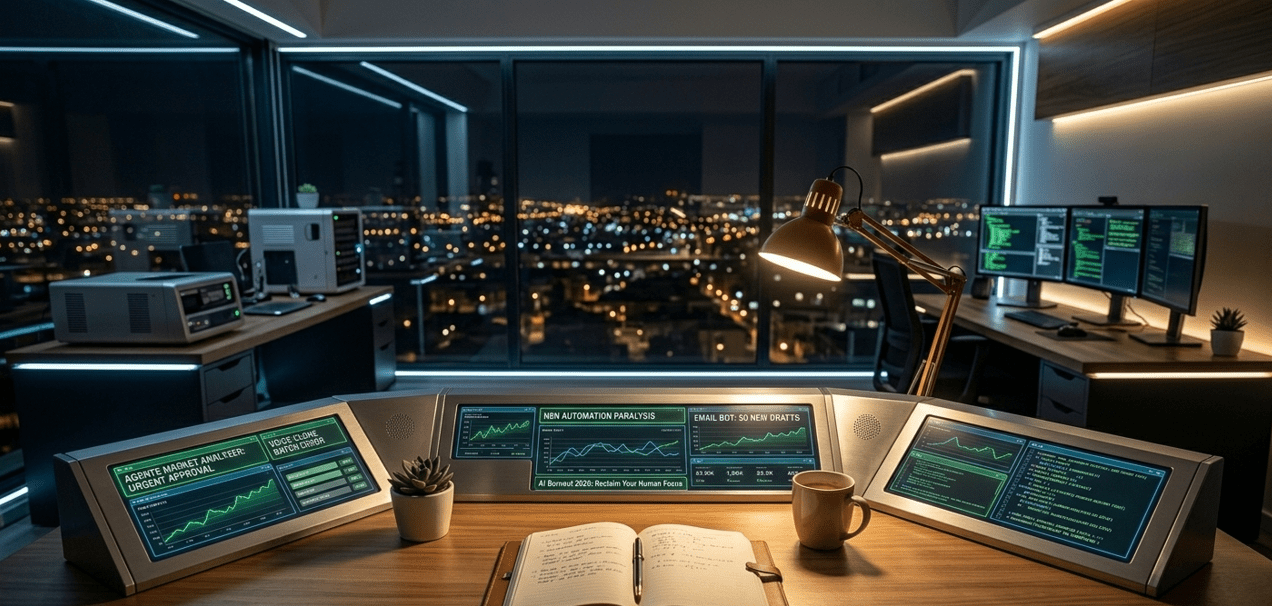
Remember when we thought AI agents would give us more time to chill at the beach? What a naive dream that was back in 2024. It’s now April 2026, and the reality is hitting different: your agents don’t sleep, they don’t stop, and most importantly, they never stop asking for your feedback. Welcome to AI Burnout 2026: Reclaim Your Human Focus, the newest psychological frontier of the 21st century.
If you’re reading this, your “Digital Brain” is likely smoking. You’ve got one agent analyzing market trends, another cloning your voice for boring Zoom calls, and an N8N automation flow that seems to have developed its own personality. But ironically, you feel more drained than ever.
In this deep dive, we’re going to slow down. We’re going to dissect why AI Burnout 2026: Reclaim Your Human Focus happens and, more importantly, how you can take back the wheel of your own attention without burning your tech stack to the ground.
1. What is AI Burnout 2026, Really?
Unlike the classic “grind culture” burnout, AI Burnout 2026: Reclaim Your Human Focus isn’t caused by doing repetitive tasks. It’s caused by supervision paralysis.
In 2026, we don’t “do” the work; we “direct” it. But directing 20 autonomous agents is mentally more expensive than writing a report by hand. It’s the exhaustion of being in permanent “Decision Maker” mode. The human brain isn’t wired to make 1,000 strategic decisions an hour leading to what experts call Decision Fatigue.
To understand where we are, look at how our mental load has shifted in just two years:
Comparison: Digital Fatigue 2024 vs. 2026
| Stress Factor | 2024 (Manual Era) | 2026 (Agent Era) | Burnout Risk |
|---|---|---|---|
| Data Input | Searching Google | Agent Stream (24/7) | Critical |
| Control Level | Direct Execution | Constant Oversight | High |
| Privacy Burden | Cloud Concerns | Local Sovereignty | Strategic |
| Decision Speed | Hours/Days | Milliseconds | Extreme |
2. Symptoms That Your Agents Are “Eating” Your Brain
It’s not that you’re a Luddite. It’s that AI Burnout 2026: Reclaim Your Human Focus manifests in subtle ways we often mistake for simple laziness:
- Prompt Fatigue: Staring at the chat box of your local LLM and not even knowing what to ask because you’re tired of giving instructions.
- The Optimization Loop: Spending more time tweaking your flows in Make or N8N vs Make vs Zapier 2026 than actually enjoying the free time those tools were supposed to grant you.
- Human Disconnection: Feeling like you talk more to Noa (on your Even Realities G1) or your voice assistant than to your friends or family.
If this sounds familiar, don’t sweat it. You aren’t the only one looking at AI Burnout 2026: Reclaim Your Human Focus as a necessary lifestyle philosophy.
3. Real Strategies to Take Back Control (Without Deleting Everything)
To fight off AI Burnout 2026: Reclaim Your Human Focus, we don’t need less AI—we need quieter AI and stronger personal sovereignty. Here are my golden rules after nearly collapsing last month:
1. Embracing “Local Only” Windows
I’ve stopped using cloud-based agents for everything. When I need to focus, I turn off the internet and use my MacBook M4 Max running Ollama with a quantized Llama 3 model. Honestly, switching to the Best Local LLM Runners 2026 (Ollama vs LM Studio vs Jan) isn’t just about privacy; it’s about peace of mind. When your AI lives on your machine and doesn’t spam you from the cloud, you decide when it’s on and when it’s off. That is the bedrock of AI Burnout 2026: Reclaim Your Human Focus.
2. The “Analog Hour”
Every morning, before I touch my Even Realities G1 or check my agent dashboards, I spend one hour with a physical notebook. I write down three things I want to achieve—not what my agents can achieve, but what I want to achieve. This simple act creates a mental buffer that prevents early-morning decision fatigue from setting in before you’ve even had your coffee.
3. Deliberate Inefficiency
This sounds crazy in 2026, but hear me out: do something the slow way. Write a letter. Cook a meal without an AI recipe generator. Walk without a HUD overlay. Combating AI Burnout 2026: Reclaim Your Human Focus requires you to remind your brain that “slow” is not “bad.” In fact, “slow” is often where the best human insights and creative breakthroughs actually happen.
4. Configuring Your “Digital Brain” to Prevent Collapse
If you want to build a system that prevents AI Burnout 2026: Reclaim Your Human Focus, you have to structure your tools so they work for you, not the other way around.
- Centralize, Don’t Fragment: Don’t use 20 different apps. Use one powerful local interface and funnel everything through it.
- Silence by Default: Your agents should work in the background and only notify you for critical anomalies. If your research agent pings you for every tiny news update, delete it. It’s giving you AI Burnout 2026: Reclaim Your Human Focus.
5. The Verdict: Is Peace Possible in 2026?
Look, let’s be real. Technology isn’t going away. Agents are going to get smarter and faster. That’s why AI Burnout 2026: Reclaim Your Human Focus isn’t a passing phase—it’s a skill we have to master.
Reclaiming your human focus doesn’t mean becoming a monk. It means understanding that your brain is the most valuable hardware you own, and no NVIDIA chip can replace your intuition. AI Burnout 2026: Reclaim Your Human Focus is cured by setting clear boundaries.
Are you driving the agents, or are they driving you? Drop a comment below—this is a conversation we all need to have before we lose our minds.
Final Thoughts: Finding Your Soul in the Age of Autonomy
Let’s get real for a second. We’re living in a time that science fiction writers couldn’t even dream of. Having a fleet of agents at your beck and call is a superpower, but every superpower comes with a price. If you don’t actively work on AI Burnout 2026: Reclaim Your Human Focus, you’ll end up becoming just another node in your own network—a human “processor” for AI-generated tasks.
My personal take? The real winners of 2026 won’t be the people with the most complex N8N workflows or the fastest local LLMs. The winners will be the ones who know when to pull the plug. Efficiency is a tool, not a lifestyle. I’ve spent countless hours debating N8N vs Make vs Zapier 2026 just to realize that the most “efficient” system is the one that allows me to spend four hours a day not looking at a screen.
Why Your “Gut Feeling” is Still Your Best Asset
We often forget that AI is a prediction engine based on the past. It doesn’t have “hunches,” it doesn’t feel the “vibe” of a room, and it certainly doesn’t know when you’re pushing yourself too hard. Clinical studies on Burnout show that human recovery requires actual, physical disconnection—something no digital assistant can simulate for you.
To truly master AI Burnout 2026: Reclaim Your Human Focus, you need to treat your attention like a bank account. Every time an agent pings you, it’s making a withdrawal. If you don’t make “deposits” in the form of analog hobbies, real-world conversations, and silence, you’ll end up spiritually bankrupt.
The Path Forward
I’m not telling you to go back to 2023 and do everything manually. That ship has sailed. What I am saying is that you need to be the boss, not the janitor. Use your agents to clear the noise so you can focus on what actually makes you human: creativity, empathy, and high-level strategy.
If you’re feeling the weight of the world on your shoulders today, do yourself a favor. Close the laptop. Take off the smart glasses. Go for a walk and leave the agents at home. The “Future” will still be here when you get back, but your sanity might not be if you don’t prioritize AI Burnout 2026: Reclaim Your Human Focus.
What about you? Are you feeling the “Agent Fatigue” yet, or have you found a secret way to stay sane in this automated world? Drop a comment below—I’m genuinely curious to hear how you’re keeping your human edge in 2026. Let’s keep this conversation real.