
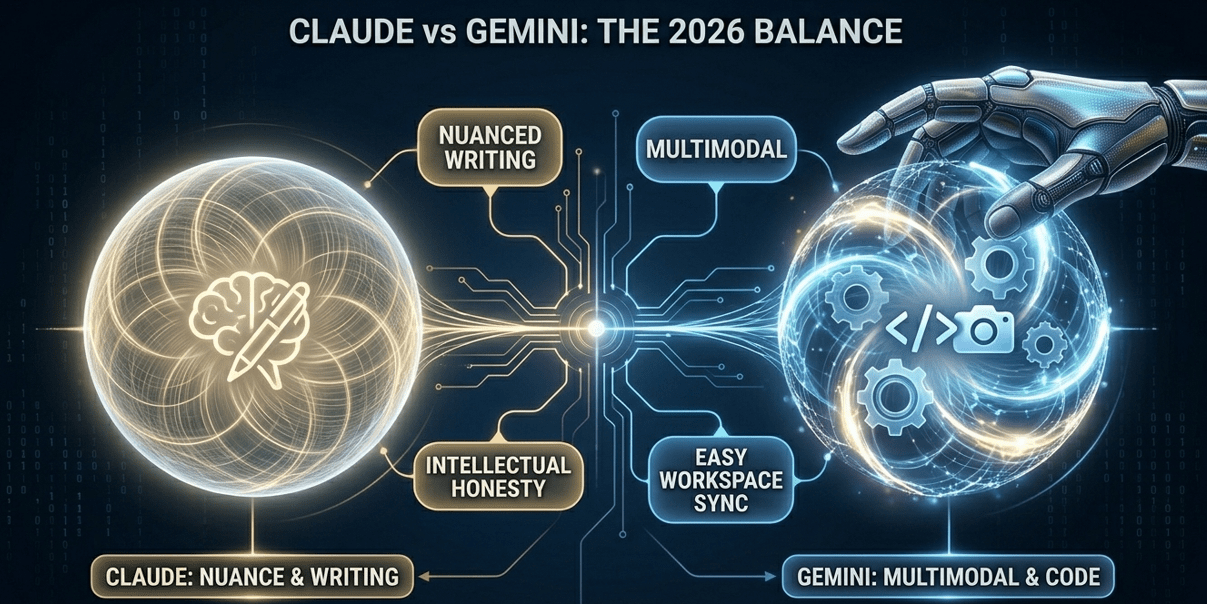
The Claude vs Gemini debate has become one of the most relevant conversations in AI right now. Both models have matured significantly over the past year, both sit at the top of most benchmark leaderboards, and both are capable enough that the average user will rarely hit a wall with either. But they have meaningfully different strengths, different personalities, and different ecosystems around them — and those differences matter depending on what you actually use an AI assistant for.
This Claude vs Gemini comparison cuts through the noise and gives you a clear, honest picture of where each model excels, where each one falls short, and which one fits your specific workflow in 2026.
What Is Claude?
Claude is Anthropic’s flagship AI assistant, available at claude.ai. The current generation — Claude Sonnet 4 and Opus 4 — represents a significant step forward in reasoning depth, long-context handling, and what Anthropic calls “character consistency”: the tendency to maintain a coherent, thoughtful tone even across complex, multi-step conversations.
Claude has built a strong reputation for nuanced writing, careful analysis, and intellectual honesty. It tends to acknowledge uncertainty rather than fabricate confident-sounding answers, which makes it particularly trustworthy for research and professional writing tasks. For a deeper look at what Claude can do with structured content generation, our guide on how to use Claude 3.5 Sonnet Artifacts covers one of its most practical features. If you want to see how Claude stacks up against ChatGPT specifically, our Claude vs ChatGPT-4o comparison is worth reading alongside this one.
What Is Gemini?
Gemini is Google’s AI assistant, available at gemini.google.com. The current generation — Gemini 2.5 Pro and Flash — positions Google’s model as one of the strongest multimodal AI systems available, with particularly impressive performance on reasoning benchmarks and code generation.
What makes Gemini distinct in the Claude vs Gemini equation is its deep integration with Google’s ecosystem. Gemini works natively inside Gmail, Google Docs, Google Sheets, Google Drive, and the broader Workspace suite. For anyone whose workflow is already built around Google’s tools, that integration alone is a meaningful advantage. Our dedicated guide on how to use Gemini walks through everything the platform can do in practice.
Claude vs Gemini: Reasoning and Analysis
Both models perform well on complex reasoning tasks, but they approach problems differently. Claude tends to think through problems in a more structured, step-by-step way, making its reasoning process visible and easier to follow. This is especially valuable for tasks where understanding the logic matters as much as getting the answer — legal analysis, financial modeling, strategic planning.
Gemini 2.5 Pro introduced extended thinking capabilities that bring it closer to Claude’s deliberative approach. On standardized reasoning benchmarks, the gap between the two has narrowed considerably in 2026. For practical everyday analysis tasks — summarizing documents, building arguments, identifying contradictions — both models perform at a level that most users will find hard to distinguish.
Claude vs Gemini: Writing Quality
This is where Claude has traditionally led, and it still does. Claude produces prose that reads more naturally and with more stylistic range than most competing models. It handles tone shifts well, adapts to different voices and formats effectively, and produces long-form content with better structural coherence. For anyone using AI in a writing-heavy workflow — content creation, copywriting, reports, emails — Claude’s output typically requires less editing.
Gemini writes well, and the gap has closed, but its output can occasionally feel slightly more formulaic on longer pieces. For short-form writing — email drafts, quick summaries, structured responses — the Claude vs Gemini writing difference is minimal. For anything over 800 words, Claude’s advantage becomes more noticeable.
Claude vs Gemini: Coding
Here the Claude vs Gemini comparison tips in Gemini’s favor. Gemini 2.5 Pro has posted some of the strongest scores on coding benchmarks in 2026, and in practical use it handles complex multi-file codebases, debugging, and code explanation with impressive accuracy. Its ability to reason about large amounts of code in a single context window is a genuine strength.
Claude is also a capable coding assistant — Claude Sonnet 4 performs well on most standard coding tasks — but for developers working on complex, long-context programming challenges, Gemini currently has a slight edge. Both models outperform general-purpose tools for code generation; the question is whether that edge matters for your specific use case.
Claude vs Gemini at a Glance
Here’s how Claude vs Gemini compare across the key criteria:
| Category | Claude | Gemini |
|---|---|---|
| Writing Quality | ✅ Excellent | ✅ Very good |
| Reasoning Depth | ✅ Excellent | ✅ Excellent |
| Coding | ✅ Very good | ✅ Excellent |
| Multimodal | ✅ Good | ✅ Excellent |
| Google Workspace Integration | ❌ No | ✅ Native |
| Context Window | ✅ 200K tokens | ✅ 1M tokens |
| Free Tier | ✅ Yes | ✅ Yes |
| Paid Plan | $20/month (Pro) | $19.99/month (Advanced) |
| Factual Reliability | ✅ Very high | ✅ High |
| Web Search | ✅ Yes (paid) | ✅ Yes (both tiers) |
Claude vs Gemini: Multimodal Capabilities
Gemini was designed as a multimodal model from the ground up, and it shows. Image understanding, audio processing, video analysis, and document parsing all feel native rather than added. For workflows that involve analyzing visual content, processing mixed media, or working with complex documents, Gemini has a clear structural advantage in the Claude vs Gemini multimodal matchup.
Claude handles image and document analysis well and has improved considerably in this area, but its roots are in text and its strongest capabilities remain text-based. For most users whose AI tasks are primarily text-driven — writing, analysis, research, coding — this difference rarely matters. For users working regularly with images, video, or mixed media, it does.
Claude vs Gemini: Pricing
The Claude vs Gemini pricing comparison is almost a draw at the individual level. Claude Pro costs $20 per month and gives you access to the full Claude model family, higher usage limits, and priority access. Gemini Advanced costs $19.99 per month and includes the top Gemini model tier plus integration across all Google Workspace apps.
For teams already paying for Google Workspace, Gemini Advanced is often included or discounted, which shifts the value calculation significantly. Our comparison of ChatGPT Plus vs Gemini Advanced covers the broader subscription value question if you’re weighing multiple AI subscriptions at once.
Both tools offer genuinely usable free tiers, so there’s no cost barrier to testing both before deciding.
Which One Should You Choose?
The honest answer is that the right choice in the Claude vs Gemini debate depends almost entirely on where you spend your time.
Choose Claude if writing quality is a priority, if you work on tasks that require nuanced analysis and intellectual precision, if you value a model that admits uncertainty rather than confabulates, or if you want an AI assistant that feels consistent and trustworthy across long, complex conversations. It fits naturally into the broader productivity workflows covered in our AI tools for productivity guide.
Choose Gemini if you live in Google’s ecosystem, if coding is a significant part of your AI usage, if you need strong multimodal capabilities, or if the context window size matters for your use case. The native Workspace integration alone justifies the choice for many professionals already deep in Google’s tools.
There’s no wrong answer here. The Claude vs Gemini gap has narrowed enough in 2026 that either model will serve most users well — the decision is more about ecosystem fit than capability differences.
Final Thoughts
The Claude vs Gemini comparison doesn’t produce a clear winner because neither model was built to win the same race. Claude prioritizes depth, precision, and writing quality. Gemini prioritizes breadth, integration, and multimodal power. Both are excellent. Both are evolving fast.
If you’re trying to understand where Claude and Gemini fit in the broader landscape of AI models competing at the frontier, our Grok 3 vs ChatGPT 5 comparison rounds out the picture of where the top AI assistants stand heading into the next generation.
Try both free tiers with your actual tasks. That single hour of testing will tell you more than any comparison article.