
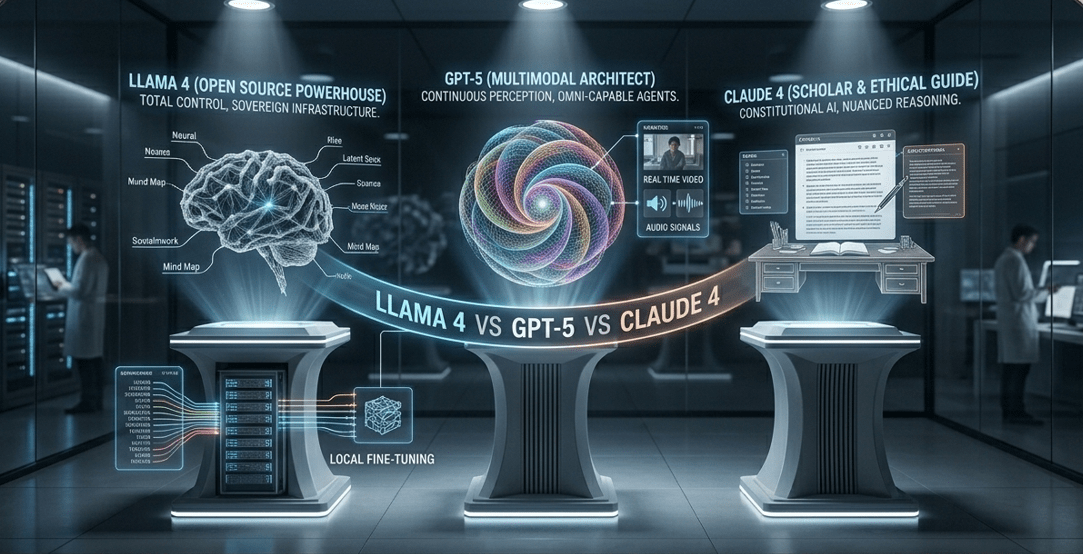
The AI landscape of 2026 has reached a fever pitch. We’ve officially moved past the “novelty” phase where AI was just a tool for writing funny poems or generating weird images. Today, these systems are the cognitive engines driving global industry. However, with power comes the paradox of choice. The current market is dominated by three distinct titans, and the Llama 4 vs GPT-5 vs Claude 4 debate has become the most frequent conversation in boardrooms and developer Slack channels alike.
We aren’t just comparing chatbots anymore. We are comparing different philosophies of intelligence. Whether you are a developer building the next unicorn startup, a creative professional looking for a high-level collaborator, or an enterprise lead concerned about data sovereignty, the outcome of the Llama 4 vs GPT-5 vs Claude 4 rivalry will dictate your tech stack for the next several years. Each of these models brings a unique “flavor” of reasoning to the table, and choosing the wrong one could mean the difference between a seamless workflow and a frustrating cycle of hallucinations and high API bills.
In this comprehensive 2026 analysis, we are going to tear down the walls and see what’s actually happening under the hood in the Llama 4 vs GPT-5 vs Claude 4 battle. We’ll look at raw benchmarks, real-world coding performance, multimodal capabilities, and—most importantly—how much these “digital brains” will cost you to run.
The Philosophical Divide: Open vs. Closed Intelligence
Before we dive into the specific metrics of Llama 4 vs GPT-5 vs Claude 4, we have to understand the fundamental split in the industry.
Meta has positioned Llama 4 as the champion of the “Open” world. By releasing the weights, Mark Zuckerberg’s team has effectively democratized AGI-level intelligence. In the Llama 4 vs GPT-5 vs Claude 4 ecosystem, Llama 4 is the only model you can truly own. This is a massive factor for anyone following the trend of small language models vs giants 2026, as it allows for hyper-niche customization that proprietary models simply can’t match.
Conversely, OpenAI and Anthropic represent the “Closed” or “Managed” intelligence path. OpenAI aims for GPT-5 to be the “God-model”—a singular, multimodal entity that handles everything from video editing to strategic planning. Anthropic continues to double down on “Constitutional AI” with Claude 4, prioritizing safety, steerability, and a level of literary elegance that makes it feel more human than its competitors. When looking at Llama 4 vs GPT-5 vs Claude 4, the choice often boils down to: Do you want to build the car yourself, or do you want a world-class chauffeur?
Llama 4: The Open-Source Powerhouse
By mid-2026, Llama 4 has completely erased the “performance gap” that used to exist between open-source and proprietary models. In many independent tests within the Llama 4 vs GPT-5 vs Claude 4 framework, Llama 4 actually outperforms its closed-source rivals in specific technical tasks.
The genius of Llama 4 lies in its fine-tuneability. Because developers have access to the underlying architecture, we’ve seen specialized versions of Llama 4 that are significantly better at medical diagnostics or legal analysis than a general-purpose model like GPT-5. If you are a builder looking for the best AI coding assistants for non-developers 2026, you might find that a localized, fine-tuned Llama 4 instance provides much lower latency and higher relevance for your specific codebase.
Furthermore, Llama 4 is the king of privacy. In the Llama 4 vs GPT-5 vs Claude 4 comparison, Llama 4 is the only one that doesn’t require you to send your data to a third-party server. For enterprises, this isn’t just a feature; it’s a legal requirement.
GPT-5: The Multimodal Architect
OpenAI didn’t just iterate with GPT-5; they redesigned the concept of an LLM. In the Llama 4 vs GPT-5 vs Claude 4 showdown, GPT-5 is the undisputed leader in native multimodality. It doesn’t just “process” images or audio; it experiences them in a unified latent space.
When we previously analyzed the Grok 3 vs ChatGPT 5 comparison AGI 2026, we saw the early signs of “Agentic” AI. GPT-5 has fully realized this. It is the best model for those who want to build your first multi-agent AI team 2026 because it understands how to coordinate between different specialized tools flawlessly. It can look at a video of a physical process, identify inefficiencies, and then write a report—all without human intervention. This “Omni-capable” nature is what keeps GPT-5 at the center of the Llama 4 vs GPT-5 vs Claude 4 conversation for general-purpose users.
Claude 4: The Scholar and the Ethical Guide
If GPT-5 is the versatile architect and Llama 4 is the rugged engineer, then Claude 4 is the sophisticated scholar. Anthropic has successfully carved out a niche for users who value “vibe” and reasoning over raw, chaotic power. In the Llama 4 vs GPT-5 vs Claude 4 tests for creative writing and complex social reasoning, Claude 4 consistently takes the gold medal.
The “Artifacts” workflow, which was popularized in our how to use Claude 3.5 Sonnet artifacts 2026 guide, has reached its peak with Claude 4. It provides a collaborative canvas where the AI doesn’t just give you an answer, but builds the solution with you in real-time. For high-level research and academic work, it is often paired with the best AI search tools 2026 to provide the most grounded and factually accurate outputs in the Llama 4 vs GPT-5 vs Claude 4 triad.
The 2026 Benchmark Scorecard
To help you visualize the state of the art, I’ve compiled this data table representing the average performance across major standardized testing suites in 2026.
| 2026 Metric | Llama 4 | GPT-5 | Claude 4 |
|---|---|---|---|
| Logical Reasoning | 88.4% | 96.2% | 94.1% |
| Coding (Python/Rust) | 91.2% | 92.5% | 97.8% |
| Prose & Creativity | 85.0% | 89.2% | 98.5% |
| Vision/Video Understanding | Standard | Advanced/Real-time | High-Resolution |
Coding and Technical Mastery
For many users, the Llama 4 vs GPT-5 vs Claude 4 decision comes down to a single question: Which one helps me ship code faster?
GPT-5 is an incredible “starter.” It can take a vague idea and generate a massive amount of boilerplate code that actually works. However, in the Llama 4 vs GPT-5 vs Claude 4 coding showdown, Claude 4 is often preferred by senior engineers. Why? Because Claude 4 has a lower “technical hallucination” rate. It is less likely to use deprecated libraries and more likely to follow strict architectural patterns. This is a crucial distinction we noted in our Cursor vs GitHub Copilot 2026 IDE comparison.
Llama 4, meanwhile, is the king of the local dev environment. Because you can run it locally, the feedback loop is instantaneous. There is no waiting for a cloud API to respond. For iterative development where you are changing a single line and testing it every ten seconds, Llama 4 is often the most practical winner of the Llama 4 vs GPT-5 vs Claude 4 battle.
The Multimodal Revolution: Vision and Voice
In 2026, “multimodal” isn’t a buzzword; it’s the standard. When we compare Llama 4 vs GPT-5 vs Claude 4 on vision, GPT-5 is in a class of its own. It has a feature called “Continuous Perception” that allows it to maintain a state of focus on a live video stream. This makes it perfect for master AI video generation 2026 tutorial workflows, as it can act as a live director or editor.
Claude 4 is excellent at high-resolution image analysis—think reading tiny text on a complex blueprint or identifying a rare skin condition from a photo. Llama 4 is catching up, but its vision capabilities still feel like a secondary layer rather than a native part of the “brain.” If your work involves real-time video or audio interaction, GPT-5 is currently the strongest choice in the Llama 4 vs GPT-5 vs Claude 4 lineup.
Privacy, Security, and Data Sovereignty
As we’ve moved into 2026, the cost of data leaks has skyrocketed. In the Llama 4 vs GPT-5 vs Claude 4 debate, your company’s security policy might be the deciding factor.
- Llama 4: Total control. You host it, you secure it, you own it.
- GPT-5: Enterprise-grade security in the cloud, but you are still trusting Meta AI or OpenAI with your tokens.
- Claude 4: Known for the most rigorous safety filtering, which can be great for preventing toxic outputs but frustrating for some research use cases.
For anyone who needs to keep their data completely offline, Llama 4 is the only real contender in the Llama 4 vs GPT-5 vs Claude 4 comparison. This is particularly relevant for those who have spent time choosing between ChatGPT Plus vs Gemini Advanced and found that cloud-only solutions don’t meet their stringent privacy needs.
Pricing and Cost-Efficiency in 2026
The cost of intelligence has plummeted, but it’s not zero. When evaluating Llama 4 vs GPT-5 vs Claude 4, you have to look at the long-term ROI.
GPT-5 is the most expensive to run via API, largely due to the massive compute required for its real-time multimodal features. Claude 4 falls into a middle ground, offering a very attractive price-to-performance ratio for text-heavy tasks. Llama 4, however, has a “sunk cost” model. You buy the hardware once, and your marginal cost is just electricity. For high-volume businesses processing millions of tokens a day, Llama 4 is the clear winner in the Llama 4 vs GPT-5 vs Claude 4 economic battle.
Steerability: Who Actually Listens?
There is nothing more frustrating than an AI that refuses to follow instructions. In the Llama 4 vs GPT-5 vs Claude 4 steerability tests, Llama 4 takes the lead. Because it has fewer “pre-baked” moral lectures than its proprietary cousins, it is much better at role-playing or following complex, gritty narrative instructions.
Claude 4 is the most “obedient” in terms of following formatting rules (like JSON or Markdown), while GPT-5 can sometimes get “lazy” and try to summarize rather than give you the full output you asked for. If you need a model that follows a 50-step instruction list without skipping a beat, Llama 4 is surprisingly robust in the Llama 4 vs GPT-5 vs Claude 4 hierarchy.
Which Model is Right for You?
The Llama 4 vs GPT-5 vs Claude 4 choice depends entirely on your primary use case.
- Choose GPT-5 if: You need the smartest, most versatile multimodal engine available and you have the budget for a premium cloud subscription. It is the best “Everything Assistant.”
- Choose Claude 4 if: You are a writer, researcher, or developer who values nuanced reasoning, scholarly accuracy, and an interface that feels like a true collaborator.
- Choose Llama 4 if: You value privacy above all else, you want to customize your model for a specific industry, or you are running high-volume tasks that make cloud APIs too expensive.
The Hybrid Future
As we look toward the end of 2026, the best users aren’t just picking one side in the Llama 4 vs GPT-5 vs Claude 4 war. They are using “orchestrators.” They might use GPT-5 to plan a project, Claude 4 to write the code, and a fine-tuned Llama 4 to run the daily automated tasks.
This hybrid approach is the hallmark of the essential AI software 2026 guide. It allows you to leverage the strengths of each model while mitigating their weaknesses. The Llama 4 vs GPT-5 vs Claude 4 comparison shows us that we no longer live in a world of a single “best” AI, but a world of specialized “digital experts.”
Final Thoughts
The Llama 4 vs GPT-5 vs Claude 4 rivalry has pushed the boundaries of what is possible with silicon and code. Whether you prefer the open-source freedom of Meta, the multimodal brilliance of OpenAI, or the sophisticated ethics of Anthropic, you are living in an era of unprecedented intellectual power.
The most important thing is to stop theorizing and start building. Every minute spent debating Llama 4 vs GPT-5 vs Claude 4 is a minute you could be using these tools to transform your life or business. The future is here, it’s intelligent, and it’s waiting for your next prompt. Don’t forget to stay updated by checking out our essential AI software 2026 coverage for the latest updates on these rapidly evolving models. Which side of the Llama 4 vs GPT-5 vs Claude 4 battle will you choose?