
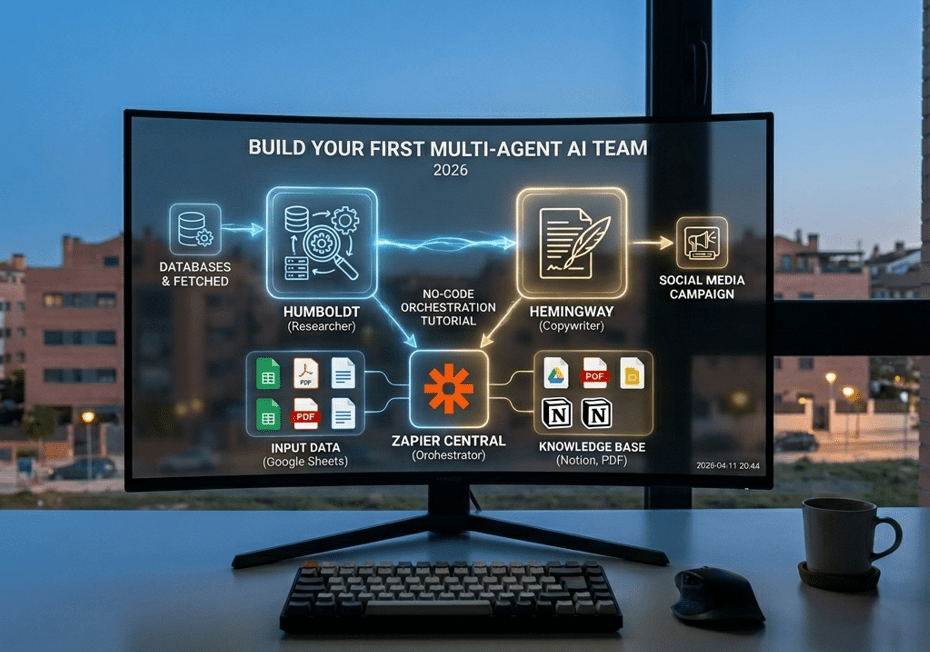
Last month, I hired my first two employees. They don’t drink coffee, they don’t take holidays, and they work 24/7. One is a brilliant researcher named “Humboldt,” and the other is a concise copywriter named “Hemingway.” The best part? They aren’t real. They are autonomous AI agents that I built in an afternoon, and they collaborate to create my weekly industry newsletter.
If you are still using ChatGPT as a simple chatbot, you are living in 2024. In 2026, the game is no longer about “prompting”; it’s about “orchestration.” If you want to scale your business or your personal output, you need to learn how to Build Your First Multi-Agent AI Team 2026. This tutorial is not for developers; it is a 100% no-code guide using CrewAI (via Zapier Central) to create a digital workforce that thinks, collaborates, and executes complex tasks for you.
From Chatbots to Agents: The Orchestration Paradigm
Before we dive into the setup, we need to understand the shift. A standard LLM (like GPT-4) is a “reactive” tool. You ask, it answers. An AI Agent is “proactive.” It has a goal, memory, and, most importantly, the ability to use tools (like a browser or an email client) to achieve that goal.
The real magic happens when you connect multiple agents into a “Crew.” When you Build Your First Multi-Agent AI Team 2026, you are creating a decentralized intelligence network. Agent A completes a task, critiques it, and passes the optimized result to Agent B. This is context-aware collaboration, and it’s the ultimate power move for professional productivity in 2026.
Why You Need a Multi-Agent AI Team in 2026
The complexity of modern work requires specialized knowledge. A single, generic AI model will often hallucinate or provide bland, non-actionable advice when tasked with a multifaceted project.
By deciding to Build Your First Multi-Agent AI Team 2026, you create dedicated specialists. One agent focuses on searching the web, another focuses on strategic analysis, and a third focuses on final tone-of-voice and formatting. As we explored in our recent comparison of the Best Local LLM Runners 2026, having dedicated context is key. Today, we bring that specialization to the automation layer.
The Tools You Need for this No-Code Tutorial
You don’t need a Python environment for this. We are using enterprise-grade automation platforms to lower the barrier. To successfully Build Your First Multi-Agent AI Team 2026, you will need:
- A Zapier Central Account: This is our central hub where we will connect and define our agents. It acts as the orchestration layer.
- An LLM Backend: We recommend connecting to OpenAI’s GPT-5 or Anthropic’s Claude 4.5 via API.
- A Data Source (Google Drive/Notion): Where your agents can find company-specific knowledge.
Step-by-Step: Constructing Your Crew in Zapier Central
Let’s build a specific example: A “Content Engine Crew.” This crew will automate the creation of a social media campaign for a new product launch.
Step 1: Defining the Agents (The Persona)
Log into Zapier Central and click “Create New Agent.” We will create two distinct roles to form our first Build Your First Multi-Agent AI Team 2026.
Agent 1: The “Lead Researcher” This agent is responsible for the raw data. In its definition, use a precise prompt:
“You are an expert market analyst named ‘Humboldt.’ Your mission is to find and synthesize the 3 most critical pain points of customers for [Product Type]. You have access to Google Search and my private [Data Source]. Your output must be a concise, context-rich brief that will be passed to a copywriter. You prioritize data over generic advice.”
By defining this specialized role, you ensure the research has the context required to effectively Build Your First Multi-Agent AI Team 2026.
Agent 2: The “Campaign Strategist” Now, create a second agent. This agent waits for Humboldt’s output. Define its definition:
“You are a concise, viral-focused copywriter named ‘Hemingway.’ Your mission is to take the user pain points provided by ‘Humboldt’ and transform them into a 5-part social media sequence (Twitter/LinkedIn). Your goal is to generate engagement and book discovery calls. Your tone is professional, punchy, and empathetic. You always review your draft twice before finalizing.”
This distinct separation of research and execution is why you need to Build Your First Multi-Agent AI Team 2026 instead of asking a single AI to “write a social media campaign.”
Step 2: Orchestration (The Sequential Workflow)
Now that you have your specialists, we need to tell them how to talk to each other. This is the “sequential orchestration” that makes the crew work. In Zapier Central, create a “New Workflow.”
- Trigger: Create a trigger based on a “New Product” entry in a Google Sheet (or manually via a form).
- Action 1 (Lead Researcher): Send the product name to “Humboldt” and ask for the research brief.
- Action 2 (Campaign Strategist): Send Humboldt’s completed brief to “Hemingway” and ask for the social media drafts.
- Final Action: Send Hemingway’s drafts to your “Drafts” folder in Google Docs or email it to yourself for final approval.
This specific workflow is the skeleton of how to Build Your First Multi-Agent AI Team 2026.
Comparative Analysis: Standard vs. Multi-Agent Workflows
Troubleshooting: Living with Your Digital Workforce
The biggest mistake when you Build Your First Multi-Agent AI Team 2026 is not setting clear “guardrails.” Agents can “hallucinate” in complex tasks, leading to what is known as an “agentic loop,” where they repeatedly critique themselves without making progress.
How to Fix It: If Humboldt keeps finding irrelevant data, update its “persona.” Give it examples of what “good research” looks like by uploading a few of your best reports to its Data Source. When you Build Your First Multi-Agent AI Team 2026, your primary job is no longer to do the work, but to train the AI to think like you. For advanced RAG implementation details, consult the Ollama local RAG guide.
Privacy and Ethics: Security in an Agentic World
One of the most critical questions when people decide to Build Your First Multi-Agent AI Team 2026 is: “Is my data safe?” Agents, by design, need deep access to your systems (files, email history).
In 2026, you must use tools that offer robust permissions. In Zapier Central, you can explicitly define what data each agent can access. Never give an agent full “Read/Write” access to your entire business drive. Just as you secured your AI Agents for Inbox Zero, you must maintain a secured perimeter for your crew. When you Build Your First Multi-Agent AI Team 2026, privacy is non-negotiable.
Frequently Asked Questions (FAQ)
What LLMs are best for a multi-agent team? For the “researcher” role, Claude 4.5 Opus is unmatched due to its massive context window. For the “strategist” and “executor” roles, GPT-5 excels at reasoning and tool-use. Choosing the right “brain” is a crucial step when you Build Your First Multi-Agent AI Team 2026.
Is it expensive to run multiple agents? The software (Zapier Central) has a subscription. The LLM APIs (OpenAI/Anthropic) are pay-per-use. Running a crew for a complex newsletter might cost $0.50 per run. When you Build Your First Multi-Agent AI Team 2026, you are trading computing costs for human labor costs—the ROI is almost immediate.
Do I need programming knowledge? No. This tutorial is designed for users who can define a goal. The skill shifts from coding to “persona-prompting” and managing the workflow logic. This makes it accessible for anyone looking to Build Your First Multi-Agent AI Team 2026.
My Honest Take: The Cognitive Preserve
We have reached the end of the line for manual information processing. In 2026, the volume of data is too high to manage alone. Learning how to Build Your First Multi-Agent AI Team 2026 is not a luxury; it’s a necessary skill for long-term career resilience.
By taking two hours this weekend to set up your Humboldt and your Hemingway, you aren’t just automating a newsletter. You are reclaiming your most valuable asset: your deep-thinking time. The “start-up cost” of creativity is the biggest hurdle. Let your crew handle the research, the initial synthesis, and the first messy draft. Your job is to approve the strategy, add the human empathy, and click “Send.”
Go build your first crew. It’s the closest thing to having a superpower that I’ve found in this digital age.